
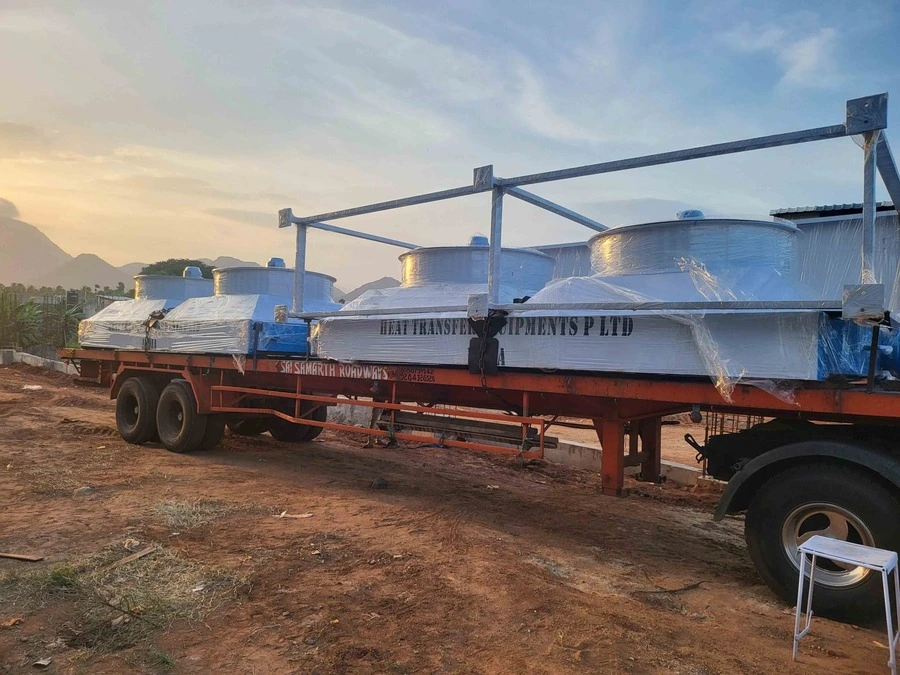
1. Heat Exchanger Manufacturers in India – HTEPL
Heat Transfer Equipments Pvt. Ltd. (HTEPL) is an industrial heat exchanger manufacturer based in Coimbatore, Tamil Nadu, India. We design, manufacture and supply custom heat exchangers for industrial heating, cooling and condensation applications across India and overseas.
Our manufacturing range includes shell and tube heat exchangers, air cooled heat exchangers, plate heat exchangers, double pipe heat exchangers, marine heat exchangers, condensers and air preheaters.
We design heat exchangers based on the customer's process requirements, including fluid properties, flow rate, operating temperature, pressure and allowable pressure drop. Customers can also provide existing equipment drawings for replacement heat exchanger requirements.
Our manufacturing facility has in-house engineering, fabrication, material inspection and pressure testing facilities. We serve industries such as oil and gas, chemical processing, petrochemical, power generation and marine.
HTEPL operates under an ISO 9001:2015 certified quality management system and holds ASME U-Stamp authorization for applicable pressure equipment.
For new projects or replacement requirements, customers can submit their process datasheets or equipment drawings to our engineering team for a custom heat exchanger quotation.
2. List of 20 Leading Heat Exchanger Manufacturers in India
Heat Transfer Equipments Pvt. Ltd. (HTEPL), Alfa Laval India, TEMA India, L&T Heavy Engineering, Godrej Process Equipment and The Anup Engineering are among the established heat exchanger manufacturers in India. Some companies manufacture a wide range of industrial heat exchangers, while others specialize in equipment for specific industries or operating conditions.
The table below lists 20 manufacturers, their selected manufacturing locations and major heat exchanger specializations.
| Company | Manufacturing Location | Specialization |
|---|---|---|
| Heat Transfer Equipments Pvt. Ltd. (HTEPL) | Coimbatore, Tamil Nadu | Shell and tube, air cooled, plate, finned tube and custom industrial heat exchangers |
| Alfa Laval India Pvt. Ltd. | Pune and Satara, Maharashtra | Plate and compact heat exchangers |
| The Anup Engineering Ltd. | Ahmedabad, Gujarat | Shell and tube and specialized process heat exchangers |
| Bharat Heavy Electricals Ltd. (BHEL) | Hyderabad, Telangana | Surface condensers, feedwater heaters and power plant heat exchangers |
| Ganesh Filter | Tiruchirappalli, Tamil Nadu | Shell and tube and air cooled heat exchangers |
| GMM Pfaudler Ltd. | Ahmedabad, Gujarat | Special alloy heat exchangers and heavy process equipment |
| Godrej Process Equipment | Dahej, Gujarat | Large and high-pressure process heat exchangers |
| HRS Process Systems Ltd. | Pune, Maharashtra | Corrugated tube and scraped surface heat exchangers |
| ISGEC Heavy Engineering Ltd. | Yamunanagar, Haryana | Shell and tube and high-pressure process heat exchangers |
| Kinam Engineering Industries Pvt. Ltd. | Ambernath, Maharashtra | Shell and tube, corrugated tube and spiral heat exchangers |
| KRN Heat Exchanger and Refrigeration Ltd. | Neemrana, Rajasthan | Fin and tube coils, bar and plate heat exchangers |
| L&T Heavy Engineering | Hazira, Gujarat | Heavy-duty process heat exchangers and screw plug heat exchangers |
| Mazda Ltd. | Ahmedabad, Gujarat | Surface condensers, feedwater heaters and steam condensing systems |
| Patels Airtemp (India) Ltd. | Rakanpur and Kadi, Gujarat | Air cooled, shell and tube and finned tube heat exchangers |
| Precision Equipments (Chennai) Pvt. Ltd. | Chennai, Tamil Nadu | Shell and tube and specialized process heat exchangers |
| Radiant Heat Exchanger Pvt. Ltd. | Pune, Maharashtra | Shell and tube heat exchangers and pressure equipment |
| Steelcon Engineering LLP | Ankleshwar, Gujarat | Shell and tube heat exchangers made from stainless steel and special alloys |
| TEMA India Pvt. Ltd. | Palghar, Maharashtra | Shell and tube and screw plug heat exchangers |
| Thermotech Engineering (India) Pvt. Ltd. | Pune, Maharashtra | Stainless steel and nickel alloy process equipment and heat exchangers |
| Universal Heat Exchangers Ltd. | Coimbatore, Tamil Nadu | Shell and tube heat exchangers and industrial cooling equipment |
Note: This is a non-ranked list based on published manufacturing locations and product specializations. Some companies operate additional manufacturing facilities.
A manufacturer specializing in refrigeration coils may not manufacture high-pressure heat exchangers for refineries. Similarly, a heavy process equipment manufacturer may not be the most suitable choice for a small oil cooler or compact plate heat exchanger.
Use the product specializations in the table to prepare an initial shortlist. Confirm the required equipment size, operating conditions and manufacturing capabilities with each company before requesting a quotation.
3. Types of Heat Exchangers Manufactured in India
Heat exchanger manufacturers in India produce several types of heat exchangers, including shell and tube, air cooled, plate, finned tube and double pipe heat exchangers. They also manufacture specialized equipment such as surface condensers, kettle reboilers, high-pressure heaters and air preheaters for specific industrial applications.
The type of heat exchanger required depends on the process fluid, operating pressure, temperature, cooling medium and cleaning requirements.
| Heat Exchanger Type | Suitable Applications |
|---|---|
| Shell and Tube Heat Exchanger | High-pressure and high-temperature heating and cooling in refineries, chemical plants and power plants. |
| Air Cooled Heat Exchanger | Process fluid cooling using ambient air, particularly where cooling water is limited. |
| Plate Heat Exchanger | Compact liquid-to-liquid heating and cooling in food processing, dairy, HVAC and chemical plants. |
| Finned Tube Heat Exchanger | Heat transfer between liquids or steam and air, particularly where additional surface area is required on the air side. |
| Double Pipe Heat Exchanger | Smaller heat transfer duties and selected high-pressure process applications. |
| U-Tube Heat Exchanger | Applications with significant thermal expansion between the shell and tubes. |
| Fixed Tubesheet Heat Exchanger | Applications where the shell-side fluid causes limited fouling or can be cleaned chemically. |
| Floating Head Heat Exchanger | Applications requiring thermal expansion allowance and mechanical cleaning of the outside tube surfaces. |
| Kettle Reboiler | Vapor generation for distillation columns in refineries and chemical plants. |
| Surface Condenser | Condensing turbine exhaust steam using cooling water in thermal power plants. |
| Air Cooled Condenser | Condensing steam or refrigerant vapor using ambient air. |
| High Pressure Heater | Heating boiler feedwater using extraction steam in power plants. |
| Marine Heat Exchanger | Marine engine jacket water cooling, lubricating oil cooling and other onboard cooling requirements. |
| Flue Gas Air Preheater | Recovering waste heat from flue gas to heat incoming combustion air. |
| Steam Coil Air Preheater | Heating combustion air using steam before it enters a furnace or downstream air preheater. |
Some of these heat exchangers belong to the same construction family. For example, U-tube, fixed tubesheet and floating head heat exchangers are different types of shell and tube heat exchangers. Fin fan coolers and air fin coolers are commonly used names for air cooled heat exchangers.
The construction type also affects maintenance requirements. A fixed tubesheet heat exchanger has straight tubes that can be cleaned internally, but its tube bundle cannot be removed for mechanical cleaning of the outside tube surfaces. A floating head design allows bundle removal, making it more suitable when shell-side deposits require regular mechanical cleaning.
At Heat Transfer Equipments Pvt. Ltd. (HTEPL), we manufacture custom shell and tube, air cooled, plate, double pipe and marine heat exchangers, along with condensers and air preheaters. The equipment configuration is selected based on the customer's process and operating requirements.
4. Which Heat Exchanger Manufacturer Is Suitable for Your Application?
Choose a heat exchanger manufacturer with experience in your required equipment type, operating pressure, temperature and construction materials. Standard heating and cooling applications may require established product designs, while high-pressure or corrosive applications often require custom engineering.
For example, a conventional air cooled heat exchanger cannot cool a process fluid to 35°C when the ambient air temperature is 40°C. The manufacturer must evaluate alternative cooling methods.
If you have only processed operating data, choose a manufacturer with thermal and mechanical design capabilities. If approved manufacturing drawings are already available, a qualified fabrication company may be sufficient.
Experience with similar equipment and operating conditions is more important than the number of products in a manufacturer's catalogue.
5. Heat Exchanger Design and Engineering Capabilities
A heat exchanger manufacturer should have both thermal and mechanical design capabilities to ensure that the equipment achieves the required heat transfer duty and operates safely under the specified pressure and temperature conditions. These two design requirements are closely related because changes in tube size, material, thickness and arrangement can affect both heat transfer and mechanical strength.
Thermal Design and Performance Requirements
Thermal design determines the heat transfer surface area required to achieve the specified fluid outlet temperatures. Manufacturers calculate this area using the fluid properties, flow rates, temperature difference, heat transfer coefficient and fouling allowance.
The following parameters should be considered during thermal design.
| Design Parameter | Why It Matters |
|---|---|
| Heat duty | Determines the amount of heat that must be transferred. |
| Fluid flow rate | Affects heat duty, fluid velocity and pressure drop. |
| Inlet and outlet temperatures | Determine the required heating or cooling duty and available temperature difference. |
| Heat transfer coefficient | Affects the surface area required for heat transfer. |
| Allowable pressure drop | Limits the flow resistance through the heat exchanger. |
| Fouling allowance | Accounts for the additional thermal resistance caused by deposits on heat transfer surfaces. |
| Cooling water or ambient air temperature | Determines the cooling conditions available to achieve the required outlet temperature. |
Heat transfer and pressure drop must be considered together. For example, increasing the fluid velocity inside the tubes generally improves convective heat transfer, but it also increases pressure drop. The manufacturer must select a tube arrangement that provides the required thermal performance without exceeding the allowable pressure drop.
Before approving the design, buyers should request a thermal datasheet showing the calculated heat duty, outlet temperatures, heat transfer area, fouling allowance and pressure drop on both fluid sides.
The thermal performance guarantee should also specify the operating conditions under which the required performance must be achieved.
Mechanical Design and Construction Requirements
Mechanical design determines the material thickness, construction arrangement and structural strength needed to withstand the specified design pressure, temperature and mechanical loads.
For shell and tube heat exchangers, mechanical design includes the shell, tubesheets, tubes, headers, flanges, nozzles and equipment supports.
| Design Requirement | Why It Matters |
|---|---|
| Design pressure | Affects the required thickness and strength of pressure-retaining components. |
| Design temperature | Affects material selection and allowable material stress. |
| Thermal expansion | Determines whether the construction must accommodate differential expansion between components. |
| Nozzle size and position | Affect piping connections, fluid distribution and installation. |
| Tube supports and baffles | Support the tubes and help control flow-induced vibration. |
| Equipment supports | Must withstand equipment weight and applicable external loads. |
| Maintenance accessibility | Determines the space required for cleaning, inspection and tube bundle removal. |
For example, in a fixed tubesheet heat exchanger, the shell and tubes may expand by different amounts when they operate at different temperatures. Since both ends of the tubes are attached to fixed tubesheets, this difference in expansion can produce thermal stress. The manufacturer must evaluate these stresses and determine whether an expansion joint or a different construction type is required.
Buyers should request applicable mechanical design calculations, general arrangement drawings, material specifications and nozzle details before fabrication begins.
A heat exchanger that meets mechanical construction standards does not necessarily meet the required thermal performance. Both design reviews are necessary before approving the equipment for manufacturing.
6. Heat Exchanger Materials and Construction Options
Heat exchangers are manufactured using carbon steel, stainless steel, copper alloys, duplex stainless steel, titanium and other alloy materials. The material is selected based on the process fluid, operating temperature, pressure, corrosion conditions and expected equipment life.
All components of a heat exchanger do not necessarily have to be made from the same material. For example, a shell and tube heat exchanger may have a carbon steel shell and stainless steel tubes when the shell-side fluid is compatible with carbon steel but the tube-side fluid requires greater corrosion resistance.
Common Materials Used in Heat Exchanger Manufacturing
| Material | Common Applications | Selection Consideration |
|---|---|---|
| Carbon Steel | Steam, oil and treated water applications | Economical but requires suitable corrosion protection in corrosive environments. |
| Stainless Steel 304/304L | Food processing, clean water and mild chemical applications | Suitable for many general corrosion-resistant applications. |
| Stainless Steel 316/316L | Chemical processing and selected chloride-containing fluids | Offers better resistance to pitting corrosion than SS 304, but has limitations in high-chloride environments. |
| Copper and Copper Alloys | HVAC, marine cooling and oil coolers | Good thermal conductivity, but suitability depends on fluid chemistry. |
| Low Alloy Steel | High-temperature refinery and power plant applications | Provides suitable strength at elevated temperatures, depending on the grade. |
| Duplex Stainless Steel | Oil and gas, chemical and selected marine applications | Offers high mechanical strength and improved resistance to chloride-related corrosion. |
| Titanium | Seawater cooling and selected corrosive chemical applications | Excellent resistance to seawater corrosion under suitable operating conditions. |
| Nickel-Based Alloys | Highly corrosive chemical and specialized high-temperature applications | Higher material cost and specific fabrication requirements. |
| Aluminium | Air cooled heat exchanger fins and selected compact heat exchangers | Good thermal conductivity and low weight. |
The material requirements also depend on the heat exchanger construction. Shell and tube heat exchangers may use different materials for the shell, tubes, tubesheets and baffles. Plate heat exchangers require compatible plate and gasket materials, while air cooled heat exchangers commonly use aluminium fins attached to carbon steel or stainless steel tubes.
How Operating Conditions Affect Material Selection
The operating conditions determine how well a material resists corrosion, maintains its strength and transfers heat throughout the equipment's service life.
Fluid composition is particularly important. For example, stainless steel 316 may perform well with treated cooling water but can develop pitting or crevice corrosion when exposed to seawater. Titanium or a suitable copper-nickel alloy may be considered for seawater cooling, depending on water chemistry, temperature and flow conditions.
Other operating factors that affect material selection include:
- Operating temperature: High temperatures can reduce the allowable stress of certain materials, while low temperatures may increase the risk of brittle fracture in unsuitable steel grades.
- Design pressure: Higher pressure may require thicker components or materials with higher allowable stress.
- Fluid velocity: Excessive velocity, particularly when fluids contain solid particles, can cause erosion and reduce tube wall thickness.
- Thermal conductivity: Lower thermal conductivity increases resistance to heat transfer through the tube or plate wall.
- Material compatibility: Contact between different metals in the presence of a conductive fluid can cause galvanic corrosion.
- Cleaning requirements: Tubes, plates, gaskets and other wetted components must be compatible with the chemicals used during cleaning.
Material selection should also consider replacement and maintenance costs. A lower-cost tube material may reduce the initial equipment price but increase the need for tube replacement if it is unsuitable for the operating fluid.
When selecting a heat exchanger manufacturer, check whether the company has experience in welding, forming and testing the specified material grades. A manufacturer experienced in carbon steel fabrication may not have the same facilities or qualified welding procedures required for titanium or nickel alloy construction.
7. Heat Exchanger Manufacturing Capacity and Limitations
Heat exchanger manufacturing capacity depends on the maximum equipment dimensions, material thickness, fabrication machinery, lifting capacity and pressure testing facilities available at the factory.
At Heat Transfer Equipments Pvt. Ltd. (HTEPL), we evaluate the following manufacturing requirements before accepting a custom heat exchanger order:
- Shell diameter and tube bundle length.
- Shell and tubesheet thickness.
- Tube finning and machining requirements.
- Material grades and welding requirements.
- Equipment weight and lifting requirements.
- Design pressure and required test pressure.
Manufacturing capacity cannot be determined by equipment dimensions alone. For example, a larger shell diameter combined with higher design pressure may require thicker plates that exceed the available plate rolling capacity.
We review these requirements together before confirming manufacturing feasibility. Equipment dimensions and weight are also checked against transportation limitations before finalizing the construction.
8. Heat Exchanger Manufacturing and Fabrication Process
The heat exchanger manufacturing process involves engineering design, material procurement, component fabrication, tube bundle assembly, welding, inspection and pressure testing. The manufacturing sequence varies depending on the type of heat exchanger, material of construction and applicable design standards.
For a shell and tube heat exchanger, the manufacturing process generally involves the following stages.
1. Engineering Design and Drawing Approval
The manufacturer reviews the customer's process datasheet and prepares the required thermal and mechanical designs. Equipment dimensions, tube arrangement, nozzle positions and material specifications are finalized before fabrication begins.
2. Material Procurement and Verification
Plates, tubes, pipes, forgings and other materials are procured according to the approved specifications. Material grades, dimensions and material test certificates are checked to ensure that the correct materials are used during fabrication.
3. Shell and Component Fabrication
Steel plates are cut, rolled into cylindrical sections and welded to form the shell. End covers, channels, nozzles, flanges and equipment supports are fabricated according to the approved drawings.
4. Tubesheet Drilling and Baffle Preparation
Tube holes are drilled into the tubesheets according to the specified tube diameter, pitch and arrangement. Baffles are prepared to support the tubes and guide the shell-side fluid.
Incorrect alignment between tubesheet and baffle holes can make tube insertion difficult and may damage the tubes during assembly.
5. Tube Bundle Assembly
The tubes are inserted through the baffles and tubesheets. The tube ends are mechanically expanded, welded or both, depending on the specified joint design.
The quality of the tube-to-tubesheet joints is important because leakage at these joints can allow the shell-side and tube-side fluids to mix.
6. Welding and Final Assembly
The fabricated components are assembled and welded using the required welding procedures. Nozzles, supports and other connections are fitted according to the equipment drawings. Post-weld heat treatment is carried out when required by the material, construction code or project specifications.
7. Inspection and Pressure Testing
Dimensional checks and applicable non-destructive testing are carried out during fabrication. After assembly, pressure testing is performed to verify the integrity of the pressure-retaining components and joints.
A successful hydrostatic test confirms pressure integrity under the specified test conditions, but it does not confirm the thermal performance of the heat exchanger.
8. Surface Preparation, Documentation and Dispatch
After the required inspections and tests are completed, the equipment undergoes surface preparation, painting or other specified finishing processes. Nozzle openings and machined surfaces are protected before packing and transportation. The required manufacturing and inspection documents are prepared for the customer.
The manufacturing process differs for other heat exchanger types. Air cooled heat exchangers require finned tube preparation, header fabrication and fan assembly, while plate heat exchangers require plate forming and gasket fitting, brazing or welding, depending on their construction.
When evaluating a heat exchanger manufacturer, buyers should check which manufacturing activities are performed in-house and which are outsourced. Operations such as tubesheet machining, tube finning and heat treatment may be subcontracted. In such cases, the manufacturer should maintain material traceability, quality control and inspection records throughout the manufacturing process.
9. Heat Exchanger Manufacturing Standards and Certifications
Heat exchanger manufacturers in India commonly follow ASME Section VIII, TEMA, API 660 and API 661 standards, depending on the equipment type and application. These standards provide requirements for equipment design, material selection, construction, fabrication, inspection and testing.
Not all heat exchangers require the same manufacturing standards. The applicable requirements depend on the operating conditions, equipment construction, customer specifications and regulations at the installation location.
ASME, TEMA and API Design Standards
The following standards are commonly specified when purchasing industrial heat exchangers.
| Standard | Applicable Equipment | Main Purpose |
|---|---|---|
| ASME Section VIII | Heat exchangers with applicable pressure-retaining components | Provides requirements for pressure vessel design, fabrication, inspection and testing. |
| TEMA | Shell and tube heat exchangers | Covers mechanical construction, tube arrangements, dimensional tolerances and other design requirements. |
| API 660 | Shell and tube heat exchangers used in petroleum, petrochemical and natural gas industries | Provides additional requirements for equipment design, materials, fabrication and inspection. |
| API 661 | Air cooled heat exchangers used in petroleum, petrochemical and natural gas industries | Covers requirements for tube bundles, headers, fans, mechanical construction and equipment performance. |
More than one standard may apply to the same heat exchanger. For example, a shell and tube heat exchanger manufactured for a refinery may require ASME Section VIII for pressure vessel construction, TEMA for mechanical design details and API 660 for additional refinery service requirements.
The applicable standard can also affect manufacturing cost. Additional requirements for material thickness, welding, inspection and documentation may increase the fabrication scope.
Buyers should specify the required standards and their applicable editions when requesting a quotation. This helps manufacturers prepare quotations based on the same technical requirements.
ISO Certification and ASME U-Stamp Authorization
ISO 9001 certification and ASME U-Stamp authorization serve different purposes in heat exchanger manufacturing.
ISO 9001 certification relates to the manufacturer's quality management system. It covers how the company manages manufacturing processes, document control, customer requirements, nonconforming products and corrective actions. It does not certify the mechanical integrity or thermal performance of an individual heat exchanger.
ASME U-Stamp authorization allows a manufacturer to construct and apply the ASME Certification Mark with the U Designator to applicable pressure vessels manufactured in accordance with ASME Section VIII, Division 1, within its authorized scope.
There is a difference between a heat exchanger designed according to ASME Section VIII and an ASME U-stamped heat exchanger. U-stamped equipment must satisfy the applicable code requirements, undergo the required authorized inspections and carry the appropriate certification marking and Manufacturer's Data Report.
Before approving a heat exchanger manufacturer, buyers should verify:
- The validity and scope of the ISO 9001 certificate.
- The validity and manufacturing location covered by the ASME authorization.
- Whether the equipment will be supplied with the ASME U-Stamp, when required.
- The applicable construction standards and inspection requirements.
- The certification and documentation included in the quotation.
At Heat Transfer Equipments Pvt. Ltd. (HTEPL), our manufacturing quality management system is ISO 9001:2015 certified, and we hold ASME U-Stamp authorization for applicable pressure equipment. Project-specific design standards, inspection requirements and certification scope are reviewed before confirming the manufacturing requirements.
Customers requiring ASME U-stamped heat exchangers or equipment manufactured according to TEMA, API 660 or API 661 should specify these requirements in their technical datasheets or purchase specifications.
10. Heat Exchanger Inspection, Testing and Quality Documentation
Heat exchanger inspection and testing verify material quality, dimensional accuracy, weld integrity and the condition of pressure-retaining components before dispatch. The inspection scope depends on the construction code and customer specifications.
Inspection and Testing Methods
| Inspection Method | Purpose |
|---|---|
| Material Inspection | Verifies material grades and traceability. |
| Visual and Dimensional Inspection | Checks surface condition, weld appearance and equipment dimensions. |
| Radiographic Testing (RT) | Detects certain internal weld defects. |
| Ultrasonic Testing (UT) | Detects internal defects and measures thickness where applicable. |
| Liquid Penetrant Testing (PT) | Detects surface-breaking defects in non-porous materials. |
| Magnetic Particle Testing (MT) | Detects surface and near-surface defects in ferromagnetic materials. |
| Positive Material Identification (PMI) | Verifies alloy composition where required. |
| Hydrostatic Testing | Verifies pressure integrity under specified test conditions. |
| Leak Testing | Identifies leakage through joints and connections. |
For shell and tube heat exchangers, the shell and tube sides are generally tested separately according to the applicable test procedure. This helps identify leakage between the two fluid circuits, which could cause process fluid contamination.
Quality Documents Buyers Should Request
The following documents should be requested where applicable:
- Material test certificates and traceability records.
- Inspection and Test Plan (ITP).
- Welding procedure specifications and qualification records.
- Welder qualification records.
- Non-destructive testing reports.
- Post-weld heat treatment records.
- Hydrostatic and leak test reports.
- Final manufacturing drawings.
- ASME Manufacturer's Data Report for applicable certified equipment.
- Third-party inspection reports.
- Operation and maintenance manual.
The inspection plan should be agreed upon before fabrication begins so that the customer or third-party inspector can attend the required inspection stages.
Before accepting the equipment, buyers should verify that the equipment identification number matches the final drawings, inspection reports and pressure test records.
11. Industrial Applications of Heat Exchangers Manufactured in India
Heat exchangers manufactured in India are used in refineries, chemical plants, power plants, food processing units, pharmaceutical plants and marine applications. Their main functions include process heating, cooling, vapor condensation and waste heat recovery.
| Industry | Application | Common Heat Exchanger Type |
|---|---|---|
| Oil and Gas | Crude oil heating and natural gas cooling | Shell and tube, air cooled |
| Petrochemical | Process cooling and distillation | Shell and tube, kettle reboiler |
| Chemical Processing | Reactor temperature control | Shell and tube, plate |
| Power Generation | Steam condensation and feedwater heating | Surface condenser, air cooled condenser, feedwater heater |
| Pharmaceutical | Purified water heating and cooling | Hygienic tubular and plate |
| Food and Beverage | Pasteurization and product cooling | Plate, tubular |
| Fertilizer | Process gas cooling and ammonia condensation | Shell and tube, air cooled |
| Steel and Metal Processing | Hydraulic oil cooling and waste heat recovery | Oil cooler, air preheater |
| Marine | Engine jacket water and lubricating oil cooling | Marine heat exchanger |
| Refrigeration and HVAC | Refrigerant condensation and evaporation | Condensers, plate, shell and tube |
| Textile | Process water heating and wastewater heat recovery | Shell and tube, plate |
| Paper and Pulp | Process liquid heating and heat recovery | Shell and tube, plate |
Heat exchanger requirements differ between industries. In power plants, condenser performance affects turbine backpressure and power output. In food and pharmaceutical plants, surface finish, cleaning access and contamination prevention are important alongside thermal performance.
12. Heat Exchanger Manufacturer vs Supplier – What Is the Difference?
A heat exchanger manufacturer produces the equipment, while a supplier sells and delivers equipment that may be manufactured by another company. Manufacturers can also supply their own products directly to customers.
| Heat Exchanger Manufacturer | Heat Exchanger Supplier |
|---|---|
| Responsible for equipment manufacturing and fabrication quality. | Sources equipment from manufacturing companies. |
| May provide thermal and mechanical design services. | May rely on the original manufacturer for engineering support. |
| Maintains manufacturing and inspection records. | Obtains manufacturing records from the original manufacturer. |
| Customization depends on its manufacturing capabilities. | Customization depends on its manufacturing partners. |
Buying directly from a manufacturer is useful when equipment requires custom design, special materials or changes to existing drawings. A supplier may be suitable when standard equipment, local stock or replacement parts are required.
Before placing an order, confirm the actual manufacturing company, factory location and responsibility for equipment performance, warranty and technical support.
13. How to Choose the Right Heat Exchanger Manufacturer in India
When choosing a heat exchanger manufacturer in India, verify its technical capabilities, manufacturing experience, quality certifications, delivery schedule and after-sales support before comparing prices.
Technical and Manufacturing Evaluation Checklist
| Evaluation Criteria | What to Check |
|---|---|
| Manufacturing Experience | Completed projects involving similar equipment and operating conditions. |
| Thermal Design | Required heat duty, outlet temperatures and allowable pressure drop. |
| Mechanical Design | Compliance with specified pressure, temperature and construction requirements. |
| Fabrication Capability | Ability to manufacture the required equipment size and material grades. |
| Quality Control | Material traceability, welding procedures and inspection facilities. |
| Performance Guarantee | Guaranteed performance under agreed operating conditions. |
| Technical Deviations | Any differences between the proposed design and project specifications. |
Request a completed technical datasheet and a list of deviations before approving the manufacturer's design.
Commercial and Supplier Qualification Checklist
| Evaluation Criteria | What to Check |
|---|---|
| Certifications | Current validity, scope and authorized manufacturing location. |
| Project References | Previous experience with similar equipment. |
| Quotation Scope | Included equipment, accessories, services and exclusions. |
| Delivery Schedule | Material availability, fabrication and testing timelines. |
| Warranty | Coverage, exclusions and manufacturer responsibilities. |
| After-Sales Support | Technical assistance and spare parts availability. |
| Payment and Delivery Terms | Payment milestones and transportation responsibilities. |
Manufacturers that cannot meet essential technical requirements should not be shortlisted based on price alone. Once the technical differences have been resolved, compare purchase prices, operating costs and delivery terms to make the final selection.
14. Heat Exchanger Price and Manufacturing Cost Factors in India
The price of an industrial heat exchanger in India depends on its heat transfer duty, construction type, material, design pressure and manufacturing requirements. Custom heat exchangers are priced according to their technical specifications rather than equipment size alone.
| Cost Factor | Effect on Price |
|---|---|
| Heat Transfer Area | Larger surface areas generally require more material. |
| Material Grade | Stainless steel, titanium and special alloys generally cost more than carbon steel. |
| Design Pressure | Higher pressure may require thicker pressure-retaining components. |
| Temperature Difference | A smaller temperature difference generally requires a larger heat transfer area. |
| Construction Type | Removable bundles and floating heads can increase fabrication costs. |
| Inspection Requirements | Additional testing and third-party inspection increase manufacturing scope. |
| Order Quantity | Multiple identical units may reduce the engineering cost per unit. |
| Transportation | Equipment weight, dimensions and delivery location affect supply costs. |
Material prices, component availability and manufacturing workload can also affect quotations.
Two heat exchangers with the same heat duty may have different prices because of differences in materials, pressure requirements or construction. Providing a complete process datasheet helps the manufacturer prepare an accurate quotation.
15. How to Compare Heat Exchanger Manufacturer Quotations
Heat exchanger manufacturer quotations should be compared based on the same operating conditions, thermal performance, mechanical design requirements, material specifications and supply scope. Comparing only the purchase price may lead to selecting equipment that costs more to operate or does not meet the required process conditions.
Before comparing prices, buyers should identify the technical and commercial differences between the quotations.
Compare Quotations Using the Same Design Basis
A fair quotation comparison requires all manufacturers to design the heat exchanger using the same process conditions and technical specifications.
| Comparison Parameter | What Buyers Should Verify |
|---|---|
| Heat Duty | Both manufacturers guarantee the same required heat transfer duty. |
| Fluid Flow Rates | Hot-side and cold-side flow rates are based on the same operating conditions. |
| Inlet and Outlet Temperatures | Both designs meet the required process temperatures. |
| Cooling Medium Temperature | The same cooling water inlet temperature or design ambient air temperature is used. |
| Pressure Drop | Calculated pressure drop on each fluid side remains within the allowable limits. |
| Fouling Allowance | Both designs account for the same specified fouling resistance. |
| Material Specifications | Material grades, corrosion allowances and component thicknesses meet the project requirements. |
| Design Pressure and Temperature | Both designs satisfy the specified mechanical design conditions. |
| Inspection and Testing | The required inspection methods, testing scope and documentation are included. |
| Supply Scope | Accessories, supports, motors, packing and transportation responsibilities are clearly identified. |
For example, one manufacturer may design an air cooled heat exchanger for an ambient temperature of 35°C, while another uses 45°C. Although both quotations specify the same heat duty, the second design must operate with a smaller temperature difference between the process fluid and cooling air.
This may require a larger heat transfer area or greater airflow, increasing the equipment price. Comparing these quotations without checking the design ambient temperature would result in an unfair price comparison.
Buyers should request a completed thermal datasheet, general arrangement drawing and technical deviation list from each manufacturer before finalizing the technical evaluation.
Initial Purchase Cost vs Long-Term Operating Cost
The initial purchase price is only one part of the total cost of a heat exchanger. Pumping power, fan power, cleaning requirements, maintenance, spare parts and equipment life also affect the overall cost.
A heat exchanger with a higher pressure drop requires more pumping power to maintain the same fluid flow rate. In plants that operate continuously, this additional electricity consumption can become significant over several years.
Consider two shell and tube heat exchanger quotations with the same heat duty, fluid flow rate, outlet temperatures and material specifications. Both designs meet the allowable pressure drop requirement, but their calculated pressure drops are different.
| Comparison Parameter | Manufacturer A | Manufacturer B |
|---|---|---|
| Purchase Price | ₹12 lakh | ₹10 lakh |
| Liquid Flow Rate | 126 m³/h | 126 m³/h |
| Pressure Drop | 0.4 bar | 0.8 bar |
| Combined Pump and Motor Efficiency | 70% | 70% |
| Electrical Power Required to Overcome Exchanger Pressure Drop | 2 kW | 4 kW |
| Annual Operating Hours | 6,000 hours | 6,000 hours |
| Electricity Cost | ₹8/kWh | ₹8/kWh |
| Annual Electricity Cost | ₹96,000 | ₹1,92,000 |
| Electricity Cost Over 5 Years | ₹4.8 lakh | ₹9.6 lakh |
| Purchase Price + 5-Year Pumping Cost | ₹16.8 lakh | ₹19.6 lakh |
Manufacturer B offers a lower initial purchase price by ₹2 lakh. However, its higher pressure drop results in an additional electricity cost of ₹96,000 per year.
Over five years, Manufacturer A provides a saving of ₹2.8 lakh despite its higher purchase price.
This example uses assumed prices and operating conditions for comparison purposes. It considers only the pumping energy required to overcome the heat exchanger pressure drop. Actual energy savings depend on the pumping system, flow control method and operating conditions. Maintenance costs, taxes, installation costs and changes in electricity tariffs are not included.
A similar comparison can be made for air cooled heat exchangers using fan power consumption. Cleaning frequency, gasket replacement, tube bundle removal and equipment downtime should also be considered when they differ between designs.
The most suitable quotation is one that satisfies the technical requirements and provides an acceptable total cost throughout the expected operating life of the heat exchanger, rather than simply offering the lowest initial purchase price.
16. Replacement Heat Exchangers, Tube Bundles and Retrofit Requirements
Replacement heat exchangers and tube bundles must match the required thermal performance, operating conditions and installation dimensions of the existing equipment. Manufacturers can develop replacement units using existing equipment drawings, technical datasheets and site measurements.
Depending on the condition of the existing heat exchanger, replacing the complete unit may not be necessary. If the shell and other pressure-retaining components are in suitable condition, replacing a damaged or corroded removable tube bundle may be a more economical option.
The following requirements should be checked before manufacturing a replacement heat exchanger.
| Replacement Requirement | Why It Matters |
|---|---|
| Existing Equipment Drawings | Provide the original construction details, dimensions and material specifications. |
| Current Operating Conditions | Help determine whether the original thermal design is still suitable for the process. |
| Nozzle Size and Position | Ensure compatibility with existing piping connections. |
| Equipment Dimensions | Ensure that the replacement unit fits within the available installation space. |
| Support and Foundation Dimensions | Help avoid unnecessary modifications to the existing foundation and mounting arrangements. |
| Tube Bundle Dimensions | Ensure compatibility with the existing shell, tubesheets and internal clearances. |
| Material of Construction | Determines resistance to corrosion, erosion and operating conditions. |
| Design Pressure and Temperature | Ensure that the replacement equipment meets the required mechanical design conditions. |
| Allowable Pressure Drop | Ensures compatibility with the existing pumping system. |
| Maintenance and Removal Space | Determines whether the equipment or tube bundle can be installed and removed without major structural modifications. |
For tube bundle replacement, the manufacturer should check the tube diameter, wall thickness, tube length, tube pitch, baffle arrangement and tubesheet dimensions. Small dimensional differences can prevent the new bundle from fitting correctly inside the existing shell.
Not all shell and tube heat exchangers have removable tube bundles. U-tube and floating head designs generally allow bundle removal, while fixed tubesheet designs may require retubing or more extensive repair work.
A replacement heat exchanger should not always be manufactured by copying the original design. If the existing equipment has experienced frequent tube leakage, corrosion, excessive pressure drop or insufficient cooling, the cause of these problems should be identified before finalizing the replacement.
For example, replacing corroded carbon steel tubes with stainless steel tubes of the same dimensions may improve corrosion resistance if the material is compatible with the process fluid. However, stainless steel has lower thermal conductivity than carbon steel. The manufacturer should review the thermal performance and material compatibility before approving the change.
Retrofit requirements may also arise when a plant increases its production capacity. Higher process flow rates can increase both heat duty and pressure drop. The original heat exchanger dimensions may no longer be sufficient to achieve the required outlet temperature.
When requesting a replacement heat exchanger or tube bundle, buyers should provide existing drawings, recent operating data, inspection reports and details of any previous equipment failures. If original drawings are unavailable, site measurements and an engineering review are required before finalizing the replacement design.
At Heat Transfer Equipments Pvt. Ltd. (HTEPL), customers can submit their existing equipment drawings and current process requirements for a replacement heat exchanger or tube bundle enquiry.
17. Why Choose Heat Transfer Equipments Pvt. Ltd. for Heat Exchanger Manufacturing?
Heat Transfer Equipments Pvt. Ltd. (HTEPL) was established in Coimbatore in 2012. We manufacture custom industrial heat exchangers and have supplied heat exchangers to customers in more than 15 countries.
Our manufacturing facility at Palathurai, Coimbatore, has separate fabrication areas for shell and tube and air cooled heat exchangers. Our manufacturing activities include tube bundle fabrication, header fabrication, welding, structural fabrication, equipment assembly, material inspection and hydrostatic testing.
Customers can work directly with our engineering team during design review and drawing approval. This is particularly useful when a heat exchanger must fit within an existing plant layout or meet specific piping and installation requirements.
Our manufacturing experience covers shell and tube heat exchangers for refinery applications and air cooled heat exchangers for chemical processing applications.
We follow an ISO 9001:2015 certified quality management system and hold ASME U-Stamp authorization for applicable pressure equipment.
Customers can discuss factory visits, third-party inspection and project documentation requirements with our team before placing an order.
Manufacturing address: S.F. No. 64/4B1, Palathurai to Kumarapalayam Road, Palathurai, Coimbatore, Tamil Nadu – 641105, India.
18. Heat Exchanger Manufacturing, Supply and Export from India
At Heat Transfer Equipments Pvt. Ltd. (HTEPL), we manufacture heat exchangers in Coimbatore, Tamil Nadu, and supply equipment to customers across India and overseas.
Before dispatch, equipment dimensions, shipping weight and transportation requirements are reviewed. For export orders, packing, inspection documents and shipping requirements are considered according to the agreed supply scope.
Large air cooled heat exchangers may be shipped with tube bundles, fans and supporting structures packed separately to reduce transportation dimensions. Buyers should confirm the site assembly requirements before placing an order.
The manufacturing completion date and site delivery date are not necessarily the same. International shipments may require additional time for customs clearance and transportation.
Customers should specify the destination country, delivery location, applicable equipment standards and required delivery terms when requesting a quotation.
19. What Information Is Required for a Heat Exchanger Quotation?
To obtain a heat exchanger quotation, buyers should provide the hot and cold fluid details, flow rates, inlet and required outlet temperatures, operating pressure, design pressure, allowable pressure drop and material requirements. These parameters help the manufacturer determine the required heat transfer area, equipment construction and manufacturing cost.
For custom heat exchangers, providing a complete process datasheet allows the manufacturer to prepare a more accurate technical and commercial quotation.
The following information should be included in a Request for Quotation (RFQ).
| Required Information | Why It Is Required |
|---|---|
| Application and Heat Exchanger Type | Identifies the purpose of heat transfer and the required equipment configuration, if already specified. |
| Hot and Cold Fluid Details | Determines fluid properties, material compatibility and heat transfer characteristics. |
| Fluid Flow Rates (kg/h or m³/h) | Helps calculate heat duty, fluid velocity and pressure drop. |
| Inlet and Outlet Temperatures (°C) | Determines the required heating or cooling duty and available temperature difference. |
| Heat Duty (kW) | Specifies the amount of heat to be transferred, if already calculated. |
| Operating Pressure | Defines the normal process pressure conditions on each fluid side. |
| Design Pressure and Temperature | Determines the mechanical design requirements. |
| Allowable Pressure Drop | Helps select the flow arrangement without exceeding the available pumping pressure. |
| Cooling Water Inlet Temperature | Determines the available cooling conditions for water cooled heat exchangers. |
| Design Ambient Temperature | Determines the air cooling conditions for air cooled heat exchangers. |
| Fouling Allowance | Helps account for deposits that reduce heat transfer performance during operation. |
| Material Specifications | Defines the required construction materials and corrosion resistance. |
| Equipment Drawings | Provides dimensions, nozzle positions and construction details for replacement equipment. |
| Installation Space | Helps determine equipment dimensions, orientation and maintenance access. |
| Applicable Manufacturing Standards | Specifies ASME, TEMA, API or other applicable project requirements. |
| Inspection and Testing Requirements | Defines the required examinations, pressure tests and third-party inspection scope. |
| Electrical Supply Details | Determines motor and fan requirements for air cooled heat exchangers where applicable. |
| Order Quantity | Helps determine production requirements and unit pricing. |
| Delivery Location and Required Date | Helps plan manufacturing, packing and transportation. |
Providing only the heat duty is not always sufficient to obtain an accurate quotation. Two heat exchangers designed for the same heat duty may require different heat transfer areas if their fluid temperatures, flow rates or fouling conditions are different.
For air cooled heat exchangers, the design ambient temperature at the installation location is particularly important. Using an ambient temperature lower than the actual site design condition may result in an undersized heat exchanger that cannot achieve the required outlet temperature during hotter operating periods.
For replacement heat exchangers, buyers should provide the existing equipment nameplate details, drawings and current operating data. Details of previous leakage, corrosion or insufficient heat transfer can also help the manufacturer evaluate whether design changes are required.
If some design parameters are unavailable, customers can submit the available process information for an initial engineering review. Any assumptions used for a preliminary quotation should be clearly stated and confirmed before finalizing the design.
At Heat Transfer Equipments Pvt. Ltd. (HTEPL), we review customer process datasheets, equipment drawings and project specifications to prepare quotations for custom industrial heat exchangers.
Send your heat exchanger requirements to our engineering team:
Email: enquiries@heattransferequipments.com
Phone: +91 94884 44777
Request a Heat Exchanger Quotation
20. Frequently Asked Questions
1. Who Are the Leading Heat Exchanger Manufacturers in India?
Established manufacturers include Heat Transfer Equipments Pvt. Ltd. (HTEPL), Alfa Laval India, TEMA India, L&T Heavy Engineering, Godrej Process Equipment and The Anup Engineering. Their product specializations and manufacturing capabilities differ.
2. How Do I Find a Reliable Heat Exchanger Manufacturer in India?
Check the manufacturer's engineering capabilities, experience with similar equipment, fabrication facilities, certifications and previous project references.
3. Can Indian Heat Exchanger Manufacturers Design Custom Equipment?
Yes. Many Indian manufacturers design custom heat exchangers based on process conditions, material requirements, equipment dimensions and installation space.
4. How Much Does an Industrial Heat Exchanger Cost in India?
Custom industrial heat exchangers do not have a fixed price. The cost depends on heat duty, equipment type, materials, design pressure and manufacturing requirements.
5. Are ASME-Certified Heat Exchanger Manufacturers Available in India?
Yes. Several Indian manufacturers hold ASME authorization for applicable pressure equipment. Buyers should verify the current authorization and confirm whether U-stamped construction is included in the quotation.
6. What Is the Difference Between a Heat Exchanger Manufacturer and a Supplier?
A manufacturer produces heat exchangers, while a supplier sells equipment that may be manufactured by another company. A manufacturer can also supply its own products directly.
7. How Long Does It Take to Manufacture an Industrial Heat Exchanger?
Manufacturing may take several weeks to several months, depending on equipment size, material availability, design complexity and inspection requirements. Confirm the project-specific schedule with the manufacturer.
8. Can Manufacturers Supply Replacement Heat Exchanger Tube Bundles?
Yes. Replacement tube bundles can be manufactured for suitable heat exchangers using existing drawings and verified equipment dimensions. The condition of the existing shell should also be evaluated.
9. Can Indian Manufacturers Export Heat Exchangers Internationally?
Yes. Indian manufacturers supply heat exchangers to overseas industrial projects. Buyers should confirm destination-specific standards, export packing, documentation and delivery terms.
10. What Information Is Needed to Request a Heat Exchanger Quotation?
Provide fluid details, flow rates, inlet and outlet temperatures, design pressure, allowable pressure drop and material requirements. Existing drawings are useful for replacement equipment.
21. Conclusion
Choosing the right heat exchanger manufacturer in India depends on the company's engineering capabilities, manufacturing experience and ability to meet your process requirements.
At Heat Transfer Equipments Pvt. Ltd. (HTEPL), we manufacture custom industrial heat exchangers in Coimbatore, India, based on customer datasheets, drawings and operating conditions.
Send us your technical requirements for new heat exchangers, replacement units or custom tube bundles.
Email: enquiries@heattransferequipments.com
Phone: +91 94884 44777