
1. Introduction
A marine heat exchanger helps keep engines and other equipment on a marine vessel cool. It removes excess heat while keeping seawater separate from coolant, oil, and other clean fluids.
This guide explains what a marine heat exchanger is, how it works, its main types and materials, common problems, maintenance needs, and how to choose the right unit.
2. What Is a Marine Heat Exchanger?
A marine heat exchanger is a cooling device used on small boats, ships, and other marine vessels. It moves heat from marine engine coolant, oil, or another hot liquid to seawater or fresh water.
The two fluids flow through separate paths and do not mix. This helps control equipment temperature and protects internal parts from direct contact with corrosive seawater.
3. Why Is a Marine Heat Exchanger Important?
A marine heat exchanger prevents engines, generators, gearboxes, and other equipment from overheating. It helps each system stay within a safe operating temperature.
It also keeps seawater separate from coolant, oil, and other internal fluids. This helps protect seals, gaskets, lubricants, and metal parts from corrosion, contamination, and heat damage.
Reliable cooling can reduce equipment failure, maintenance costs, and unexpected vessel downtime.
4. How Does a Marine Heat Exchanger Work?
A marine heat exchanger transfers heat through metal tubes or plates. Hot engine coolant, lubricating oil, or hydraulic oil flows through one circuit, while seawater or fresh water flows through a separate circuit. Heat passes through the metal surface without allowing the fluids to mix.
The process happens in four simple steps:
- Hot fluid enters the heat exchanger.
- Cooling water flows through a separate path.
- Heat moves through the tubes or plates.
- The cooled fluid returns to the marine equipment.
Separate pumps move the engine coolant and seawater through their own circuits. The coolant flows between the marine engine and the heat exchanger, while a raw water pump moves seawater through the cooling side. This cools the engine without sending seawater through the engine block or cylinder block.
An expansion tank allows the coolant to expand as it heats up and helps keep the system pressure steady. Cooling performance depends on proper fluid flow, clean surfaces, suitable materials, and correct sizing.
5. Main Components of a Marine Heat Exchanger
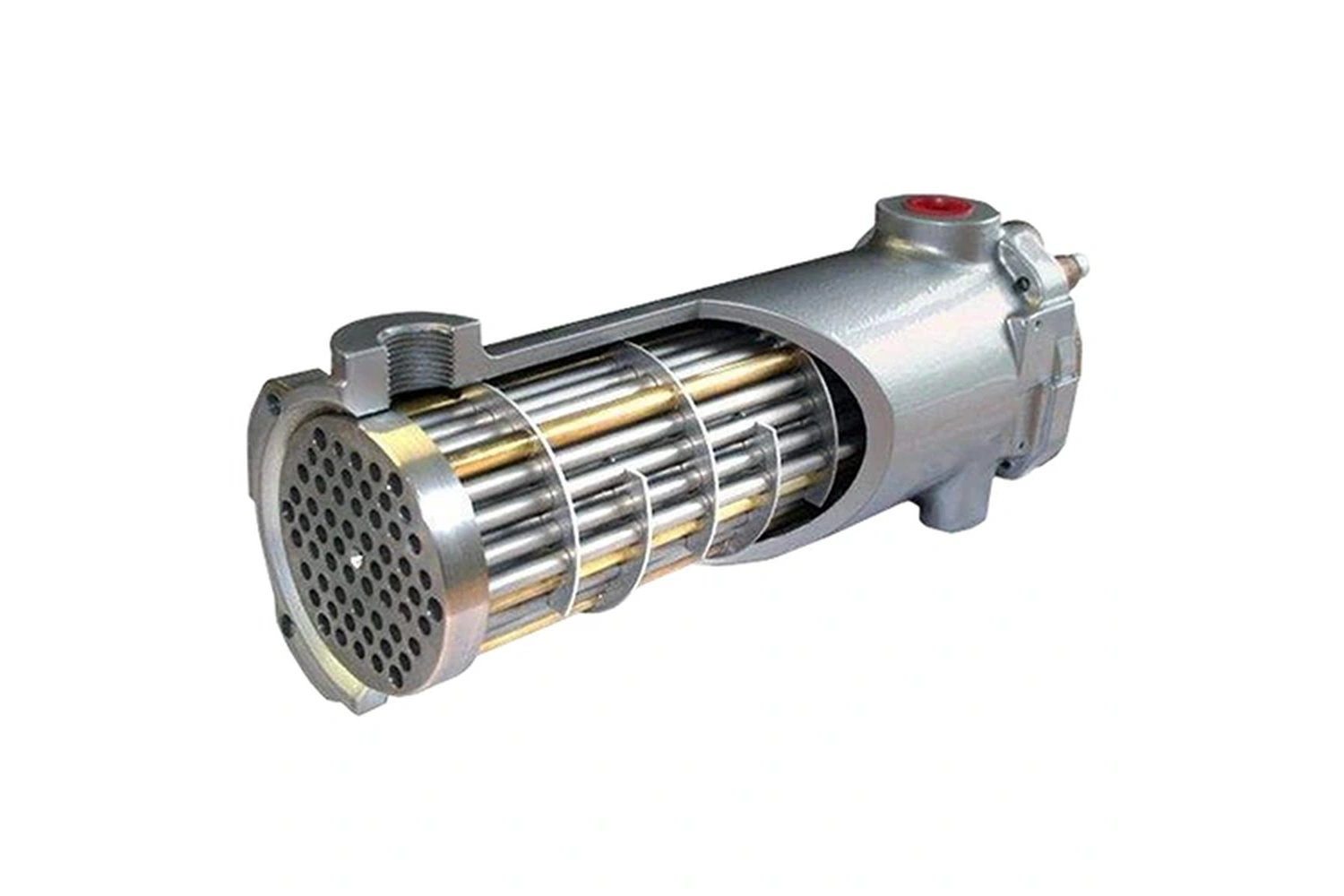
A marine heat exchanger contains several components that work together to transfer heat while keeping seawater separate from engine coolant, oil, or other onboard fluids. The exact design varies between shell and tube heat exchanger and plate heat exchanger, but the main components are similar.
| Component | Function |
|---|---|
| Shell or housing | Forms the outer body of the heat exchanger and contains the internal components. |
| Tubes or plates | Provide the surface through which heat passes from the hot fluid to the cooling water. |
| Tube bundle or plate pack | Groups the tubes or plates into the main heat-transfer section. |
| End covers or headers | Direct fluid into and out of the tubes and provide access for inspection and cleaning. |
| Inlet and outlet connections | Connect the heat exchanger to the hot-fluid and cooling-water circuits. |
| Baffles or flow guides | Direct fluid through the exchanger, improve heat transfer, and support the tubes. |
| Gaskets and seals | Prevent leaks and stop the hot and cold fluids from mixing. |
| Sacrificial anodes | Protect seawater-exposed metal parts from galvanic corrosion. |
| Mounting brackets | Secure the heat exchanger and help it withstand vessel vibration and movement. |
In some shell-and-tube units, the removable tube bundle is also called a tube stack.
Tubes and Plates
The tubes or plates are the main heat-transfer surfaces. Hot coolant, oil, or another process fluid flows on one side, while seawater or freshwater flows on the other. Heat passes through the metal, but the two fluids remain separate.
The material used for these surfaces is important. Copper-nickel, titanium, stainless steel, and other corrosion-resistant alloys may be selected depending on the fluid, seawater conditions, pressure, temperature, and required service life.
Gaskets and Seals
Gaskets create a secure seal between covers, plates, and fluid passages. Damaged, hardened, or incorrectly installed gaskets can cause external leaks or allow seawater and coolant to mix.
Gaskets should be checked during routine maintenance and replaced with the correct material and size recommended by the manufacturer.
Sacrificial Anodes
Many seawater-cooled heat exchangers contain zinc or aluminium sacrificial anodes. These anodes corrode before the main heat exchanger components, helping protect the housing, covers, and tube sheets.
Anodes should be inspected regularly and replaced before they are fully consumed.
Why Component Condition Matters?
Heat exchanger performance depends on the condition of its internal parts. Blocked tubes, fouled plates, worn anodes, damaged gaskets, and corroded surfaces can reduce cooling efficiency and increase the risk of leaks or overheating.
Routine inspection, cleaning, pressure testing, and timely replacement of worn parts help maintain reliable cooling performance.
6. Types, Applications, and Benefits of Marine Heat Exchangers
Marine heat exchangers are available in several designs and support many onboard cooling applications. Each type offers different benefits based on cooling duty, available space, fluid type, seawater conditions, and maintenance needs.
Types by Construction
Marine heat exchangers are mainly built as shell-and-tube, plate-and-frame, brazed-plate, plate-and-shell, box cooler, or keel cooler designs. The best type depends on the available space, cooling load, fluid type, seawater conditions, and maintenance needs.
| Type | Main Features |
|---|---|
| Shell-and-tube heat exchanger | Uses a bundle of tubes inside a shell. It is durable, reliable, and easy to inspect or clean. |
| Plate-and-frame heat exchanger | Uses thin plates to provide efficient heat transfer in a compact space. The plates can usually be removed for cleaning. |
| Charge-air cooler | Cools hot, compressed air from a turbocharger before it enters the marine engine. This helps increase air density and supports efficient engine operation. |
| Brazed-plate heat exchanger | Uses permanently joined plates. It is compact and commonly used with clean fluids in smaller systems. |
| Plate-and-shell heat exchanger | Combines a welded plate pack with a pressure shell for compact, high-duty applications. |
| Box cooler | It is installed in a vessel’s sea chest and transfers heat from a closed cooling circuit to the surrounding seawater. |
| Keel cooler | It is mounted on or built into the hull and transfers heat directly to the water outside the vessel. |
Some vessels use direct cooling, where raw water flows through part of the cooling system. This design is simple, but it may increase corrosion, scale, and marine growth.
Shell-and-tube units are often selected where durability and easy mechanical cleaning are important. Plate heat exchangers are commonly chosen where installation space is limited and high thermal efficiency is required.
Common Marine Applications
Marine heat exchangers support many marine applications, including:
- Main engines, auxiliary engines, and boat engines
- Diesel generators
- Gearboxes and transmissions
- Engine oil and lubrication systems
- Hydraulic and steering systems
- Charge-air cooling systems
- Fuel system cooling
- HVAC, heating, air conditioning, and refrigeration
- Water-cooled exhaust manifolds
Some heat exchangers also cool parts of the marine exhaust system where water cooling is required.
The correct heat exchanger depends on the required heat load, fluid properties, flow rate, operating pressure, seawater conditions, available space, and maintenance access.
Main Benefits
A correctly selected marine heat exchanger provides several important benefits:
- Maintains stable equipment temperatures
- Helps prevent overheating and thermal damage
- Keeps seawater separate from coolant, oil, and other sensitive fluids
- Reduces direct seawater exposure inside engines and machinery
- Supports reliable operation of onboard systems
- Provides effective cooling where air-cooled radiators are impractical
- Helps reduce unplanned shutdowns when properly maintained
Performance depends on correct sizing, suitable materials, adequate fluid flow, clean heat-transfer surfaces, and regular inspection.
7. Materials Used in Marine Heat Exchangers
Marine heat exchanger materials must resist corrosion by seawater, pressure, temperature, vibration, and fouling. Common choices include copper-nickel, titanium, stainless steel, bronze, brass, and aluminium bronze.
Copper-Nickel vs Titanium
Copper-nickel is a common and cost-effective choice for many marine cooling systems. Titanium costs more, but it offers stronger resistance to warm, polluted, or high-chloride seawater. The best choice depends on water quality, flow speed, service life, and budget.
| Factor | Copper-nickel | Titanium |
|---|---|---|
| Initial cost | Generally lower | Generally higher |
| Seawater corrosion resistance | Good under suitable conditions | Excellent |
| Weight | Higher | Lower |
| Aggressive or polluted seawater | More condition-sensitive | Usually more resistant |
| Erosion-corrosion | Can occur at excessive flow velocity | Highly resistant |
| Galvanic compatibility | Must be evaluated | Critical because titanium is highly noble |
| Typical use | General marine cooling | Aggressive seawater and long-service applications |
| Lifecycle cost | Lower purchase cost | Higher initial cost but potentially longer service life |
Copper-Nickel
Manufacturers often use copper-nickel in engine coolers, oil coolers, and seawater cooling systems. It works well when operators control seawater quality and flow velocity.
High flow velocity, suspended particles, and poor galvanic compatibility can increase the risk of erosion-corrosion. Good system design and regular maintenance can help extend the service life of copper-nickel marine heat exchangers.
Titanium
Manufacturers often choose titanium for warm, polluted, or high-chloride seawater. It offers excellent seawater corrosion resistance and works well in harsh marine conditions.
Titanium costs more than copper-nickel. However, it may provide a longer service life, better corrosion protection, and lower maintenance needs. These benefits can help reduce the total lifecycle cost of a marine heat exchanger.
Stainless Steel
Manufacturers often use stainless steel in freshwater, coolant, oil, and other controlled-fluid circuits. Engineers must choose the correct stainless steel grade for each operating environment.
Some stainless steel grades can develop pitting and crevice corrosion in chloride-rich seawater. Careful material selection helps reduce corrosion and improve heat exchanger performance.
Bronze, Brass, and Aluminium Bronze
Manufacturers use bronze, brass, and aluminium bronze for heat exchanger shells, end covers, fittings, and tube sheets. These alloys offer strength, corrosion resistance, and reliable performance in many marine applications.
Engineers choose the right alloy based on fluid chemistry, pressure, temperature, alloy composition, and compatibility with nearby metals. Good material compatibility also helps reduce the risk of galvanic corrosion.
Material selection should consider:
- Seawater temperature and salinity
- Flow velocity
- Chloride exposure
- Fluid chemistry
- Galvanic compatibility
- Fouling tendency
- Cleaning method
- Inspection access
- Expected service life
- Maintenance and lifecycle cost
- Manufacturer recommendations
There is no single best material for every marine heat exchanger. The final choice should match the actual operating conditions, fluid properties, corrosion risk, and maintenance requirements.
8. Marine Heat Exchanger vs Radiator
A marine heat exchanger and a radiator both remove excess heat, but they use different cooling methods. A radiator uses outside air that flows across metal fins. A marine heat exchanger uses seawater or fresh water to carry heat away.
Water can remove a large amount of heat in a compact space. This makes marine heat exchangers suitable for vessels with limited engine-room space and airflow.
| Feature | Marine Heat Exchanger | Radiator |
|---|---|---|
| Cooling method | Uses seawater or fresh water | Uses outside air |
| Main use | Boats, ships, and offshore equipment | Cars, trucks, and land equipment |
| Space required | Usually compact | Often needs more airflow and space |
| Common problems | Fouling, scale, corrosion, and blocked water flow | Dirty fins, blocked airflow, and fan problems |
| Fluid separation | Keeps seawater separate from engine coolant | Uses air to cool the engine coolant |
Marine heat exchangers are well suited to vessels because they can remove large amounts of heat in engine rooms with limited space and airflow.
9. Common Problems and Maintenance Warning Signs
Fouling, corrosion, blocked water flow, leaks, and damaged parts can reduce heat exchanger performance.
Common warning signs include rising engine temperature, weak seawater flow, coolant loss, unusual pressure readings, external leaks, and fluid contamination. A detailed inspection process can help identify marine heat exchanger leaks and locate the source of failure.
Operators should monitor coolant outlet temperature and pressure drop. A steady increase under similar operating conditions may show that tubes, plates, strainers, or water passages are becoming blocked.
| Problem | Common Cause | Warning Signs | Recommended Action |
|---|---|---|---|
| Fouling and scale | Marine growth, salt, sludge, or mineral deposits on tubes and plates | Higher operating temperatures, reduced heat transfer, or poor temperature difference between inlet and outlet | Clean the heat-transfer surfaces using an approved mechanical or chemical method. |
| Restricted water flow | Blocked strainers, shells, sand, debris, fouled tubes, or pump problems | Weak seawater discharge, unusual pressure readings, pump strain, or overheating | Inspect strainers, pumps, pipes, tubes, and water outlets for restrictions. |
| Corrosion and pitting | Seawater exposure, stagnant water, unsuitable materials, or galvanic corrosion | Surface damage, leaks, coolant loss, or worn sacrificial anodes | Inspect affected parts, replace worn anodes, and confirm material compatibility. |
| Erosion damage | Excessive water velocity or abrasive particles | Thinning near tube entrances, leakage, or reduced service life | Check flow conditions and inspect tubes and internal surfaces for wear. |
| Gasket or seal failure | Hardened, damaged, loose, or incorrectly installed gaskets | Drips around covers, fittings, seals, or plate edges | Replace the gasket and follow the correct tightening and torque procedure. |
| Fluid cross-contamination | Cracked tubes, damaged plates, failed seals, or corrosion | Oil in coolant, seawater in a closed circuit, unusual fluid colour, or changing fluid levels | Isolate and pressure-test the exchanger to locate the internal leak. |
| Reduced heat transfer | Dirty surfaces, insufficient flow, incorrect sizing, or damaged components | Equipment running hotter than normal or frequent overheating alarms | Compare inlet and outlet temperatures and inspect the exchanger for fouling or damage. |
Other warning signs may include unusual vibration, frequent coolant top-ups, unstable temperatures, and repeated overheating under heavy load.
Maintenance may include cleaning, flushing, gasket replacement, anode replacement, pressure testing, or repair of damaged tubes and plates. Follow the manufacturer’s instructions and use materials and cleaning methods that are compatible with the exchanger.
10. Cleaning and Maintenance Tips
Regular cleaning and inspection help maintain heat transfer, prevent flow blockage, reduce corrosion, and prevent leaks between cooling circuits. Check temperatures, pressure readings, cooling-water flow, strainers, gaskets, anodes, tubes, and plates during routine maintenance.
Cleaning depends on the exchanger type and the deposit:
| Maintenance Area | What to Do |
|---|---|
| Tube heat exchangers | Clean tubes with suitable brushes, rods, or approved tools. |
| Plate heat exchangers | Disassemble if needed, inspect plates and gaskets, and clean plate surfaces carefully. |
| Chemical cleaning | Use only chemicals compatible with the exchanger material, seals, and system fluids. |
| Seawater side | Clean strainers, remove shells, sand, sludge, and marine growth. Check for pitting and erosion. |
| Sacrificial anodes | Inspect and replace them when they are worn. |
| Freshwater, oil, and hydraulic circuits | Keep circuits clean to prevent deposits and contamination. |
When Should a Marine Heat Exchanger Be Cleaned?
A marine heat exchanger should be cleaned when cooling performance starts to fall. Common signs include rising coolant temperature, weaker seawater flow, or a higher pressure drop across the cooling side.
Do not rely only on a fixed cleaning date. Vessels operating in warm, shallow, muddy, or heavily fouled water may need more frequent cleaning than vessels operating in cold, clean water.
After cleaning, reassemble the heat exchanger using the correct gasket type, tightening sequence, torque values, and pressure-test procedure. Maintenance intervals should be based on operating hours, seawater quality, fouling conditions, inspection results, and manufacturer instructions.
11. How to Choose a Marine Heat Exchanger?
Choose a marine heat exchanger based on the heat load, fluid type, flow rate, operating temperatures, pressure, seawater conditions, available space, and maintenance access.
| Selection Factor | What to Check |
|---|---|
| Application | Main engine, generator, oil cooler, hydraulic system, HVAC, refrigeration, or service circuit. |
| Heat load | Amount of heat the exchanger must remove. |
| Temperatures | Inlet and outlet temperatures of both fluids. |
| Flow rates | Required flow of hot fluid and cooling fluid. |
| Pressure and pressure drop | Operating pressure and acceptable flow resistance. |
| Fluid type | Seawater, freshwater, coolant, lubricating oil, hydraulic oil, refrigerant, or other fluid. |
| Fouling tendency | Risk of scale, sludge, marine growth, or debris buildup. |
| Materials | Compatibility with seawater, fluid chemistry, corrosion risk, and galvanic effects. |
| Exchanger type | Shell-and-tube, plate, box cooler, oil cooler, or other suitable design. |
| Maintenance access | Space for inspection, cleaning, gasket replacement, and repairs. |
| Installation conditions | Available space, pipe layout, mounting position, vibration, and vessel movement. |
| Support and standards | Spare parts, manufacturer support, and marine classification requirements. |
Boats operating in shallow, weedy water may face blocked strainers and restricted raw-water flow. In these conditions, choose a cooling system that is easy to inspect and clean.
Shell-and-tube exchangers are durable and easier to clean mechanically, while plate heat exchangers are compact and thermally efficient. The final choice should balance cooling capacity, pressure drop, corrosion resistance, fouling risk, maintenance access, and lifecycle cost.
12. Standards and Marine Approvals
Marine heat exchangers may need to comply with pressure-vessel codes, flag-state regulations, and classification-society requirements, depending on their design, operating pressure, application, and vessel type.
Relevant standards or approvals may include:
- ASME or other applicable pressure-equipment codes
- TEMA guidelines for shell-and-tube heat exchangers
- Classification requirements from DNV, ABS, Lloyd’s Register, Bureau Veritas, or ClassNK
- Material certification, pressure testing, and inspection documentation
The required standard should be confirmed with the vessel owner, shipyard, classification society, and heat exchanger manufacturer before design or purchase.
13.Manufacturing and Testing
Each marine heat exchanger is designed according to the required heat load, fluid type, operating temperature, pressure, and seawater conditions.
Depending on the project requirements, inspection and testing may include:
- Material certificate review
- Dimensional inspection
- Weld inspection
- Hydrostatic or pressure testing
- Leak testing
- Final visual inspection
14. Conclusion
Choosing the right marine heat exchanger is important for efficient engine cooling and safe operating temperatures. It also helps protect marine equipment from damage in seawater conditions.
At Heat Transfer Equipments Pvt Ltd., we design and manufacture reliable marine heat exchangers. Our products are used in marine engines, generators, lube oil systems, hydraulic circuits, and other onboard machinery.
Our range of marine products includes heat exchangers for engines, oil systems, hydraulic systems, and other onboard cooling duties.
Our marine heat exchangers provide efficient heat transfer, corrosion resistance, durability, and reliable performance. They are designed for demanding marine and offshore applications.
With quality manufacturing and application-specific designs, we help vessels improve cooling efficiency, reduce downtime, and protect critical marine systems.
FAQ
1. How can you tell if a marine heat exchanger is blocked?
Common signs include rising engine temperature, weak seawater discharge, unusual pressure readings, and poor cooling under heavy load. Blocked strainers, tubes, or water passages may reduce flow and heat transfer.
2. Can a marine heat exchanger be cleaned without removing it?
Some units can be flushed or chemically cleaned while still installed. However, heavy scale, marine growth, damaged gaskets, or blocked tubes may require the exchanger to be opened or removed. Always use a cleaning method approved for the material.
3. Why is seawater mixing with engine coolant?
Seawater may enter the coolant circuit through a cracked tube, damaged plate, failed gasket, or corroded internal surface. The exchanger should be isolated and pressure-tested to find the leak.
4. When should a marine heat exchanger be replaced?
Replacement may be needed when tubes or plates are badly corroded, leaks keep returning, repairs are no longer reliable, or the unit cannot provide enough cooling. The decision should consider repair cost, equipment age, and operating condition.
5. Which material is best for seawater cooling?
Titanium offers excellent resistance to seawater corrosion and is often used in harsh conditions. Copper-nickel is more economical and works well in many marine systems when flow speed, water quality, and material compatibility are properly controlled.
6. How often should a marine heat exchanger be inspected?
Inspection frequency depends on operating hours, seawater quality, and cooling performance. Check the unit when coolant temperature rises, seawater flow falls, or pressure drop increases. Vessels operating in warm, shallow, or debris-filled water may need more frequent inspection and cleaning.
7. Can chemical descaling damage a marine heat exchanger?
Yes. A strong or unsuitable chemical can damage tubes, plates, seals, or brazed joints. Use only a marine-approved descaler that is safe for the exchanger material. Follow the correct mixing ratio, contact time, and flushing instructions provided by the chemical and equipment manufacturers.