
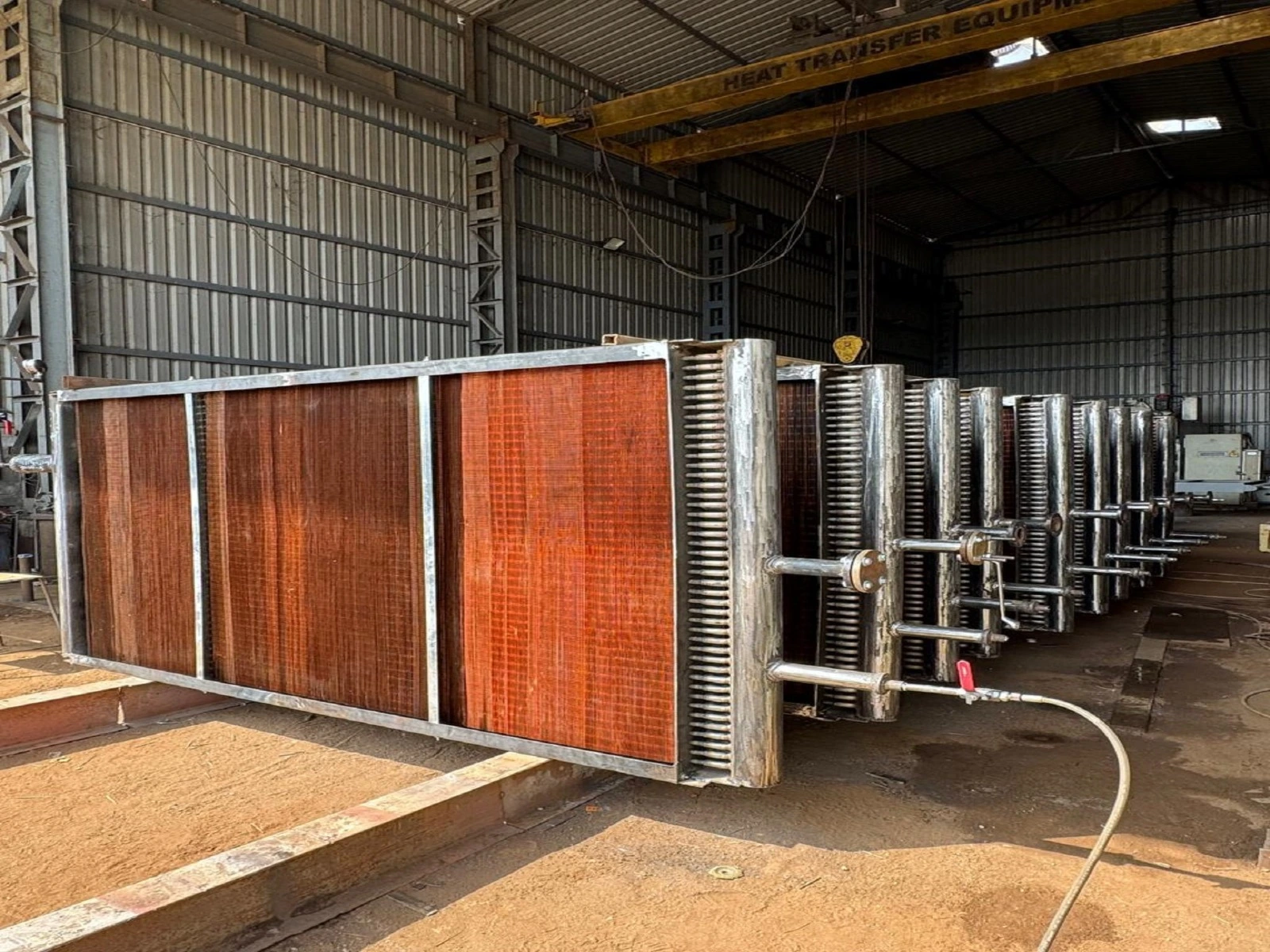
What Is a Steam Coil Air Preheater?
A steam coil air preheater is a finned-tube heat exchanger that uses steam to warm incoming combustion air. It is commonly called a SCAPH, SCAP, or steam coil air heater.
Saturated steam flows inside the metal tubes. Ambient air passes across the external fins and absorbs heat through the tube surfaces.
Key characteristics include:
- Heating medium: Saturated steam supplies thermal energy.
- Heated fluid: Ambient combustion air receives the transferred heat.
- Heat-transfer surface: Finned tubes increase the available heating area.
- System location: The unit is commonly installed in the combustion-air duct before the main air preheater or furnace.
- Primary function: It raises combustion-air temperature before downstream equipment.
The steam releases latent heat and condenses inside the tubes. The warmed air then continues toward the main furnace or air-preheating system.
A SCAPH is therefore a steam-to-air heat exchanger designed for controlled combustion-air preheating.
What Is the Function of a Steam Coil Air Preheater?
A steam coil air preheater warms incoming combustion air before it reaches the main air heater or boiler furnace.
The SCAPH uses extracted or saturated steam as its heating medium. It is commonly installed between the forced-draft fan and the main air preheater.
Its main functions include:
- Reducing acid-dew-point corrosion risk: Warmer combustion air helps keep downstream cold-end metal surfaces above the sulfuric acid dew point. This reduces corrosive condensation and fouling on air-preheater surfaces.
- Reducing sulfuric acid condensation: Higher cold-end surface temperatures reduce the chance of sulfuric acid vapour condensing on air-preheater surfaces.
- Supporting boiler startup: Steam provides air heating before enough hot flue gas is available for normal air heating.
- Stabilizing low-load operation: Controlled preheating helps maintain more stable combustion-air temperatures when the boiler operates at reduced loads.
- Supporting startup and combustion stability: Where allowed by the burner manufacturer and approved plant procedures, warmer combustion air can support ignition, flame stability, and low-load operation.
A steam coil air preheater uses finned tubes to transfer heat efficiently. Steam flows inside the tubes and releases latent heat while condensing.
Ambient air passes across the external fins and absorbs the transferred heat. The heated air then enters the main air preheater or furnace.
The main function of SCAPH is to heat combustion air during startup and low-load operation. It also helps protect equipment from corrosion.
How Does a Steam Coil Air Preheater Work?
A steam coil air preheater heats combustion air by transferring steam energy through finned metal tubes.
Hot or saturated steam enters the tubes. A forced-draft fan moves cold ambient air across their outer surfaces.
Heat passes through the tube walls and fins into the moving air. The steam releases latent heat, condenses into water, and exits through the drainage system.
Effective operation depends on steady steam flow, forced airflow, and reliable condensate removal.
- Steam flow: Steam carries thermal energy through the internal tube network.
- Airflow: The fan pushes atmospheric air across the external finned surfaces.
- Heat transfer: Colder air absorbs heat and leaves at a higher temperature.
- Condensation: Steam changes into water after releasing its latent heat.
- Drainage: Condensed water flows out through the condensate drainage system.
The heated combustion air then enters the main furnace or primary air heater.
During startup or low-load operation, hot flue gas may provide insufficient air heating. The steam coil air preheater supplies additional heat during these conditions.
Warmer incoming air raises metal temperatures at the downstream cold end. This reduces sulfuric acid condensation as long as surface temperatures remain above the applicable acid dew point.
Buyers should verify steam availability, forced-draft fan operation, and condensate drainage before selecting the equipment.
What Are the Main Components of a Steam Coil Air Preheater (SCAPH)?
A steam coil air preheater has several key parts. These parts transfer heat from steam to combustion air. They also help improve boiler performance and safe operation.
A SCAPH has several main components. These include the finned tube bundle, steam headers, condensate outlet system, and casing. It also includes control valves, drains, vents, temperature sensors, and bypass arrangements.
1. Finned Tube Bundle
The finned tube bundle is the primary heat-transfer section of a steam coil air preheater. Steam flows inside the tubes while combustion air passes over the external fin surfaces.
- Tube: Carries steam through the coil and transfers heat through the tube wall.
- Fins: Increase the external heat-transfer area and improve air-side heat exchange.
- Tube arrangement: The number of rows, tube spacing, fin density, and geometry are selected based on required heat duty and allowable pressure drop.
Common tube materials include carbon steel, stainless steel, and other corrosion-resistant alloys depending on steam conditions and operating environment.
2. Steam Inlet Header
The steam inlet header distributes incoming steam evenly across the coil tubes.
- Provides uniform steam distribution throughout the tube bundle.
- Reduces uneven heating and thermal stress.
- Designed according to steam pressure, temperature, and applicable pressure vessel requirements.
Proper steam distribution is essential to prevent cold spots and maintain consistent outlet-air temperature.
3. Return Header
The return header collects condensed steam from individual tubes and directs it toward the condensate outlet.
- Ensures effective condensate collection.
- Supports continuous drainage during operation.
- Helps prevent water accumulation inside the coil.
Poor condensate removal from the return header can lead to water hammer, reduced heat transfer, and tube damage.
4. Condensate Drain System
The condensate drainage system removes water formed when steam releases its latent heat inside the tubes.
Main components include:
- Steam traps
- Drain valves
- Condensate piping
- Vacuum breakers
- Air vents
A reliable drainage system prevents freezing, flooding, corrosion, and unstable SCAPH operation.
5. Casing and Duct Housing
The SCAPH casing provides structural support and directs combustion air through the finned tube bundle.
The casing is designed to withstand:
- Air-side pressure
- Mechanical loads
- Temperature variations
- Outdoor environmental conditions
Proper casing design reduces air leakage and ensures uniform airflow distribution across the heating surface.
6. Steam Control Valve
The steam control valve regulates the amount of steam entering the SCAPH according to required air temperature conditions.
- Controls outlet combustion-air temperature.
- Adjusts heating capacity during startup and low-load operation.
- Prevents excessive coil temperature during changing operating conditions.
Automatic control systems usually modulate steam flow based on temperature feedback from downstream air measurements.
7. Temperature Sensors and Control Instruments
Instrumentation allows operators to monitor and control SCAPH performance.
Typical instruments include:
- Air inlet temperature sensors
- Air outlet temperature sensors
- Steam pressure gauges
- Steam temperature indicators
- Condensate temperature monitoring points
- Differential pressure measurement devices
These instruments help maintain safe operation and identify performance problems early.
8. Air Bypass Damper
An air bypass damper allows combustion air to bypass the SCAPH when preheating is not required.
Functions include:
- Preventing unnecessary steam consumption during normal boiler operation.
- Supporting maintenance activities without shutting down the entire air system.
- Providing operational flexibility during different load conditions.
9. Drain Trap and Vent Arrangement
Steam coil air preheaters require proper venting to remove trapped air and non-condensable gases.
The drain and vent arrangement helps:
- Improve heat-transfer efficiency.
- Prevent air locking inside the coil.
- Maintain continuous condensate flow.
- Reduce corrosion risk.
10. Support Structure and Expansion Arrangement
SCAPH components experience thermal expansion during operation. Supports and expansion arrangements accommodate movement while maintaining mechanical stability.
- Provides safe mounting of the coil assembly.
- Allows thermal expansion of tubes and headers.
- Reduces stress on welded joints and connections.
SCAPH Component Summary
| Component | Main Function |
|---|---|
| Finned tube bundle | Transfers heat from steam to combustion air |
| Steam inlet header | Distributes steam into tubes |
| Return header | Collects condensate from tubes |
| Condensate drain system | Removes condensed steam safely |
| Casing | Supports coil and guides airflow |
| Steam control valve | Controls heating capacity |
| Temperature instruments | Monitor and regulate operation |
| Bypass damper | Controls airflow through SCAPH |
| Supports and expansion joints | Manage mechanical loads and thermal expansion |
Proper selection and integration of each SCAPH component ensures reliable heat transfer, safe condensate handling, reduced corrosion risk, and stable combustion-air temperature during boiler startup and low-load operation.
What Information Is Required to Select and Size a SCAPH?
Selecting and sizing a SCAPH requires verified air-side, steam-side, thermal, mechanical, and site data.
The design must achieve the required air-temperature rise without exceeding fan pressure or installation limits. Minimum, maximum, startup, and low-load conditions should be provided.
Air-Side Design Data
Air-side data determines heat duty, coil size, face velocity, and pressure drop.
- Air mass flow in kg/s or volumetric flow in m³/h
- Minimum inlet-air temperature in °C
- Required outlet-air temperature in °C
- Maximum allowable pressure drop in Pa or mmWC
- Minimum and maximum operating airflow
- Air pressure, dust loading, moisture, and contaminants
- Duct width, height, orientation, and available space
Steam and Condensate Data
Steam conditions determine available heat, steam consumption, and pressure-rated construction.
- Available steam pressure in bar or kPa
- Steam temperature in °C
- Saturated or superheated steam condition
- Minimum and maximum available steam flow
- Required thermal duty in kW or MW
- Condensate return pressure
- Steam-trap, drain, and condensate-routing details
Mechanical and Site Data
Mechanical information ensures the steam coil air preheater fits and operates safely.
- Tube, fin, header, and casing material requirements
- Fin type, spacing, and acceptable fouling conditions
- Horizontal or vertical installation orientation
- Maintenance, cleaning, and coil-removal clearance
- Casing pressure, vacuum, airtightness, and structural limits
- Connection sizes, flange standards, and support requirements
- Required IBR, ASME, PED, testing, and documentation scope
Complete data allows accurate thermal selection, pressure-drop evaluation, material selection, and mechanical sizing. Buyers should submit process data and duct drawings with every SCAPH quotation request.
Steam Coil Air Preheater Technical Specifications
The specifications of a steam coil air preheater (SCAPH) depend on the system requirements. These include the air flow, steam supply, operating temperature, installation, and design standards.
A good SCAPH should heat the air to the required temperature. It should also provide smooth airflow, remove condensate safely, and work reliably for many years.
Typical SCAPH Technical Specification Parameters
| Parameter | Specification Details |
|---|---|
| Equipment Type | Steam-to-air finned tube heat exchanger for combustion-air preheating |
| Heating Medium | Saturated steam or suitable process steam |
| Heated Medium | Ambient air, combustion air, or process air |
| Installation Location | Usually installed in the air duct between the forced-draft fan and main air preheater |
| Air Flow Capacity | Designed according to required combustion-air flow rate in kg/s, Nm³/h, or m³/h |
| Heat Duty | Selected based on required air-temperature rise and operating conditions, typically expressed in kW or MW |
| Air Inlet Temperature | Design ambient air temperature entering the SCAPH |
| Air Outlet Temperature | Required heated air temperature after steam coil heat transfer |
| Steam Pressure | Designed according to available steam supply pressure and equipment pressure rating |
| Steam Temperature | Saturated or superheated steam temperature based on operating conditions |
| Condensate System | Includes drain connections, steam traps, vents, vacuum breakers, and condensate return arrangement |
| Tube Material | Carbon steel, stainless steel, or corrosion-resistant alloy depending on service conditions |
| Fin Material | Aluminium, stainless steel, copper, or other selected materials based on corrosion and temperature requirements |
| Header Material | Carbon steel or stainless steel selected according to steam pressure, temperature, and code requirements |
| Casing Material | Carbon steel or specified material suitable for duct installation and operating environment |
| Tube Arrangement | Selected based on heat-transfer requirement, pressure drop, condensate drainage, and thermal expansion |
| Air-Side Pressure Drop | Designed within allowable fan capacity limitations |
| Steam Consumption | Calculated based on heat duty, steam latent heat, and operating efficiency |
| Design Standards | Manufactured according to applicable ASME, IBR, PED, or project-specific requirements |
| Testing Requirements | May include hydrostatic testing, leak testing, weld inspection, and performance verification |
| Installation Arrangement | Horizontal or vertical arrangement depending on duct layout and maintenance requirements |
Key Design Considerations for SCAPH Selection
- Thermal performance: The coil must provide the required air-temperature increase without excessive steam consumption.
- Pressure drop: Air-side resistance should remain within the forced-draft fan operating capability.
- Condensate removal: The design must ensure continuous condensate drainage to prevent water hammer and freezing.
- Material selection: Tube, fin, header, and casing materials should match steam conditions, corrosion risks, and operating environment.
- Maintenance access: The arrangement should allow inspection, cleaning, and coil replacement when required.
- Control system integration: Steam flow control, temperature measurement, and bypass operation should be considered during design.
Final SCAPH specifications should be based on actual operating data. This includes airflow, steam pressure, inlet and outlet temperatures, pressure limits, and installation conditions.
Which Steam Coil Air Preheater Design Is Right for the Application?
The right steam coil air preheater design depends on steam pressure, thermal duty, climate, space, and corrosion risk.
Available steam conditions determine whether a low-pressure or high-pressure SCAPH configuration is suitable. Ambient temperature and condensate behavior determine the required freeze-protection arrangement.
- Low-pressure design: Uses available low-pressure auxiliary, process, or waste steam. The allowable operating range depends on the manufacturer’s design, materials, pressure rating, and applicable code.
- High-pressure design: Uses higher-pressure steam where suitable pressure-rated tubes, headers, connections, controls, and condensate systems are provided. The allowable pressure must be confirmed from the equipment design pressure and applicable code.
Manufacturers may offer several proprietary or industry-recognized coil arrangements, including distributor-tube, purge-first-row, tandem, U-tube, and flexible-tube designs.
Distributor-tube designs improve steam distribution and condensate movement under variable operating conditions.
Purge-first-row or tandem arrangements may be used to improve freeze protection in very cold inlet-air conditions.
U-tube and flexible-tube arrangements accommodate thermal expansion and may simplify specific installation or maintenance requirements.
The final arrangement should be selected by the manufacturer based on steam conditions, minimum air temperature, coil orientation, condensate drainage, thermal expansion, and available space.
Stainless steel or other corrosion-resistant materials: May be selected where steam-side condensate, atmospheric contaminants, process-air contaminants, external exposure, or project requirements create a significant corrosion risk. Material selection should be based on the actual service environment, pressure, temperature, condensate chemistry, and applicable design code.
Buyers should match steam source, minimum inlet temperature, duty, layout, expansion, and fuel-related corrosion before selection. Final design should be confirmed against verified operating data, not equipment labels alone.
Where Are Steam Coil Air Preheaters Used?
Steam coil air preheaters are used in boilers, power plants, furnaces, incinerators, and process-heating systems.
They heat incoming combustion air before it reaches the main flue-gas air preheater. Installation is commonly between the forced-draft fan and the main air preheater.
Common applications include:
- Thermal power plants: SCAPH units preheat ambient air entering fossil-fueled utility boilers.
- Industrial boilers: They support controlled combustion-air heating during changing operating conditions.
- Recovery boilers: Large pulp, paper, and chemical facilities use them for high air-heating duties.
- Industrial furnaces: They supply warmer combustion air when burning high-sulfur or poor-quality fuels.
- Incinerators: Steam coils support stable air temperatures during waste-combustion processes.
- Petrochemical plants: They serve crude distillation units, steam reformers, and fired heaters.
- Process plants: SCAPH systems provide steam-based air heating for large combustion equipment.
Steam coil air preheaters are especially useful during boiler startup and low-load operation. During these periods, flue gas may not provide sufficient air heating.
They also support systems exposed to acid-dew-point corrosion. Warmer incoming air helps maintain downstream cold-end metal temperatures above damaging condensation conditions.
Buyers should evaluate steam availability, combustion-air demand, fuel sulfur, operating load, and duct location. These factors determine whether a SCAPH suits the intended industrial application.
How Is SCAPH Heat Duty and Steam Consumption Estimated?
SCAPH heat duty is estimated from airflow, air temperature rise, and air specific heat.
Heat duty represents the thermal energy transferred into the combustion or process air.
Q = ṁair × Cp,air × (Tout − Tin)
Where:
- Q: Required heat duty in kW or kJ/s
- ṁair: Air mass flow rate through the SCAPH in kg/s
- Cp,air: Air specific heat, approximately 1.005 kJ/kg·°C
- Tin: Entering ambient air temperature in °C
- Tout: Required outlet air temperature in °C
A greater airflow or temperature rise increases the required steam coil air preheater duty.
Steam consumption is estimated by dividing heat duty by the steam’s latent heat.
ṁsteam = Q / hfg
Here, hfg is the steam’s latent heat at the available supply pressure. This value should be obtained from standard steam tables.
An efficiency factor accounts for radiation and system heat losses.
ṁsteam,actual = Q / (hfg × η)
Where:
- ṁsteam,actual: Estimated steam consumption in kg/s or kg/h
- η: Estimated coil efficiency, commonly expressed as a decimal
- hfg: Latent heat of saturated steam in kJ/kg
This calculation provides a preliminary steam requirement. Final SCAPH sizing should use verified airflow, temperatures, steam pressure, and operating efficiency.
How Does a SCAPH Support Boiler Performance and Corrosion Control?
A SCAPH supports boiler startup, low-load operation, and cold-end corrosion control by warming combustion air. Its net effect on plant efficiency depends on steam consumption, fan power, pressure drop, operating load, and the available steam source.
The unit sits between the forced-draft fan and the main air preheater. Saturated steam heats incoming ambient air during startup and low-load operation.
Corrosion Control
A SCAPH can help raise the main air preheater’s cold-end metal temperature. The steam flow should be controlled so that the relevant surface temperature remains above the required corrosion-control limit determined from fuel composition, SO₃ concentration, moisture, load, and plant operating criteria.
- Sulfur-containing fuels produce sulfur dioxide during combustion, and a smaller portion may be converted to sulfur trioxide.
- Sulfur trioxide can react with water vapour to form sulfuric acid vapour. When metal-surface temperatures fall below the applicable acid dew point, the acid may condense and cause corrosion and fouling.
- Cold ambient air can reduce downstream metal temperatures and encourage acid condensation.
- Preheated combustion air helps keep cold-end surfaces warmer and reduces the risk of corrosive condensation.
- The actual level of protection depends on fuel sulfur, SO₃ concentration, moisture, surface temperature, operating load, air leakage, and the condition of the downstream air preheater.
Boiler Performance
A SCAPH provides controlled air heating when flue-gas energy is insufficient.
- During cold startup, auxiliary steam warms air before hot flue gas becomes available.
- Warmer air helps operators stabilize combustion and place burners or fuel pulverizers into service.
- At low boiler loads, SCAPH operation reduces major combustion-air temperature fluctuations.
- Controlled and gradual air heating may reduce rapid temperature changes in downstream equipment. Applicable heating rates and temperature limits should be established by the boiler and air-preheater manufacturers.
The greatest benefit occurs during cold starts, low loads, and sulfur-fuel operation. Operators should control air temperature above the required corrosion-protection limit.
Steam Coil vs Hot Water Coil—Which Is Better?
Neither coil is universally better. Steam coils are often selected where a steam utility is available and high heating duty or rapid warm-up is required. Hot-water coils may be preferred where a circulating-water system, lower operating temperatures, or broad modulation is more suitable.
The correct choice depends on heating duty, response speed, control needs, pressure, and available utility systems.
Steam Coil
A steam coil transfers latent heat from condensing steam into the passing air.
- Provides rapid startup and fast air-temperature recovery
- Delivers high heating capacity for heavy industrial duties
- Suits factories, process plants, and cold outside-air preheating
- Requires steam traps, vacuum breakers, and reliable condensate drainage
- Needs careful operation to prevent water hammer and corrosion
- May experience greater thermal expansion and pressure-related mechanical loads, depending on the steam temperature, operating pressure, startup rate, coil arrangement, and control method.
A steam coil air preheater is preferable when fast, high-capacity combustion-air heating is required.
Hot Water Coil
A hot water coil transfers sensible heat from circulating water into the air.
- Provides smooth modulation and precise temperature control
- Operates at lower temperatures and pressures
- Integrates with boilers, heat pumps, solar, or geothermal systems
- Places less thermal stress on system components
- Responds more slowly than a steam coil
- Heating capacity depends on water flow rate, supply and return temperatures, coil geometry, airflow, and heat-transfer coefficients. A hot-water coil may require a larger surface area or higher liquid flow to provide the same duty as a condensing-steam coil.
Hot water coils suit commercial buildings, schools, and offices requiring stable comfort heating.
Choose the heating medium by comparing available utilities, required heat duty, startup response, controllability, pressure rating, freeze risk, maintenance requirements, installation cost, and lifecycle energy cost.
SCAPH Supplier Selection Checklist
Selecting the right steam coil air preheater supplier requires more than comparing equipment prices. Buyers should evaluate the supplier’s thermal design capability, material selection, manufacturing standards, testing procedures, and ability to meet site-specific operating conditions.
A suitable SCAPH supplier should understand the complete application, including combustion-air requirements, steam conditions, condensate drainage, pressure-drop limitations, corrosion risks, and installation constraints.
Key points to evaluate when selecting a SCAPH supplier:
1. Thermal Design Capability
The supplier should demonstrate the ability to design the SCAPH based on actual operating data, including:
- Airflow rate and operating range
- Required inlet and outlet air temperatures
- Available steam pressure and temperature
- Required heat duty
- Allowable air-side pressure drop
- Startup and low-load operating conditions
The design should provide the required air-temperature increase without excessive steam consumption or fan-power requirements.
2. SCAPH Design Experience
A supplier with experience in industrial heat exchangers should understand common SCAPH operating challenges, including:
- Condensate removal
- Freeze protection
- Water hammer prevention
- Thermal expansion
- Uneven airflow distribution
- Fouling and corrosion control
Experience with boiler, furnace, power plant, and process-heating applications helps ensure the design matches actual operating conditions.
3. Material Selection and Construction Quality
The supplier should recommend materials based on:
- Steam pressure and temperature
- Condensate chemistry
- Air-side contaminants
- Corrosion conditions
- Operating environment
Important construction details include:
- Tube material and thickness
- Fin material and configuration
- Header design
- Casing strength
- Welding procedures
- Pressure-rated components
Material selection should follow applicable design requirements and project specifications.
4. Performance Guarantees
The technical offer should clearly define guaranteed values such as:
- Heat duty
- Outlet air temperature
- Steam consumption
- Air-side pressure drop
- Operating pressure and temperature limits
Clear guarantees help buyers compare different SCAPH designs on equal technical conditions.
5. Testing and Documentation
A reliable supplier should provide appropriate quality documents, which may include:
- Material test certificates
- Welding procedure qualifications
- Inspection records
- Hydrostatic test reports
- Leak test reports
- Dimensional drawings
- Operation and maintenance manuals
- Spare-parts recommendations
The required documentation should be agreed before order placement.
6. Installation and Retrofit Support
For replacement or retrofit projects, the supplier should review:
- Existing duct dimensions
- Forced-draft fan capacity
- Available steam connection
- Condensate return system
- Maintenance access
- Coil removal requirements
- Control system integration
Proper evaluation reduces installation problems and unexpected pressure-drop issues.
7. After-Sales Support
SCAPH suppliers should provide technical support related to:
- Installation guidance
- Startup procedures
- Operating recommendations
- Troubleshooting
- Spare parts
- Maintenance requirements
Good support helps maintain reliable operation throughout the equipment lifecycle.
What Problems and Limitations Can Occur in a Steam Coil Air Preheater?
A steam coil air preheater can experience drainage, freezing, fouling, corrosion, thermal stress, and efficiency limitations.
Most operating failures begin with trapped condensate, poor venting, uneven airflow, or rapid temperature changes.
Common SCAPH Problems and Troubleshooting
| Problem | Possible Cause | Recommended Solution |
|---|---|---|
| Low outlet air temperature | Low steam flow, incorrect control valve operation, insufficient steam pressure, or fouled heat-transfer surfaces | Check steam supply pressure, inspect control valve operation, verify condensate removal, and clean fin surfaces |
| Water hammer | Poor condensate drainage, blocked steam traps, improper coil slope, or rapid steam admission | Inspect steam traps, improve drainage arrangement, verify coil installation slope, and warm the coil gradually |
| Tube freezing or tube damage | Trapped condensate during shutdown or low ambient temperature conditions | Check drain system, maintain freeze protection, use proper shutdown procedure, and verify vacuum breaker operation |
| High air-side pressure drop | Dust accumulation, fouled fins, blocked airflow passages, or excessive fin density | Clean coil surfaces, inspect airflow distribution, and verify design pressure-drop limits |
| Steam leakage | Tube failure, header cracking, corrosion, or thermal fatigue | Perform pressure testing, inspect tube joints, repair damaged sections, and review material selection |
| Uneven air temperature | Poor airflow distribution, air bypass, or uneven steam distribution | Check dampers, inspect coil arrangement, and verify steam distribution system |
| Reduced heat transfer efficiency | Air-side fouling, internal scaling, trapped air, or condensate accumulation | Clean surfaces, remove trapped air, inspect drainage, and maintain steam quality |
Operational Problems
Operational problems can reduce heat transfer, restrict airflow, and damage tubes or joints.
- Water hammer: Poor drainage or incorrect tube pitch allows condensate to create damaging pressure waves.
- Freezing: Trapped condensate can freeze, expand, and split tubes during sub-zero ambient conditions.
- Air binding: Trapped air and other non-condensable gases can reduce heat transfer, create cold spots, and cause uneven air heating.
- Internal corrosion: Carbon dioxide dissolved in condensate can form carbonic acid, while dissolved oxygen can contribute to pitting. Proper venting, condensate removal, steam quality, and water-treatment control help reduce these risks.
- External fouling: Atmospheric dust, lint, salt, oil mist, process contaminants, or other airborne material can accumulate on the fins and restrict airflow. Fly ash or soot is relevant only where the incoming air is contaminated or recirculated from a combustion process.
- Reduced heat transfer: Fouled surfaces insulate the tubes and lower outlet-air temperature.
- Thermal fatigue: Rapid temperature changes create uneven expansion across tubes, headers, and welded joints.
- Leakage: Repeated thermal stress can crack tube-to-header connections and release steam or condensate.
System Limitations
A SCAPH requires suitable steam availability and careful performance matching across the boiler load range.
- Auxiliary steam demand: Startup operation requires an external steam source before the boiler generates steam.
- Cycle efficiency loss: Using valuable boiler steam can reduce overall cycle efficiency.
- Oversizing risk: Oversized coils can develop uneven steam distribution during very low-load operation.
- Pressure-drop limitation: Dense or fouled fins increase resistance across the combustion-air duct.
Buyers should verify drainage, venting, coil pitch, cleaning access, steam supply, and operating load range.
How Should a Steam Coil Air Preheater Be Operated and Maintained?
A steam coil air preheater should be operated gradually, drained continuously, and maintained for clean, unobstructed heat transfer.
Correct operation depends on controlled steam admission, stable airflow, effective temperature regulation, and reliable condensate removal.
Operating Procedure
A SCAPH should be warmed slowly before full steam flow begins.
- Charge the low-temperature steam header after boiler light-off and main steam-line charging.
- Open manual isolation valves around the steam control valve.
- Crack the control valve open to warm the steam lines gradually.
- Open downstream drains to remove condensate during warming.
- Close drains after steady, clear steam flow is established.
- Close bypass dampers when the SCAPH enters normal service.
- Adjust steam flow using manual or automatic temperature control.
- Maintain the approved air and cold-end temperature setpoints.
- Reduce steam gradually when boiler load increases.
- Open bypass dampers before removing the SCAPH from service.
Maintenance Requirements
Regular maintenance prevents water hammer, freezing, fouling, corrosion, and uneven air heating.
- Inspect float and thermostatic steam traps for reliable condensate discharge.
- Test vacuum breakers and air vents for correct operation.
- Maintain proper coil pitch toward the condensate return connection.
- Remove sagging sections from condensate return piping.
- Clean finned surfaces using soot blowers or compressed air.
- Remove ash, soot, and dust that restrict airflow.
- Confirm freeze protection during low ambient temperatures.
- Use clean, dry steam to reduce internal contamination.
- Monitor cold-end metal temperature during sulfur-fuel operation.
Operators should follow approved plant procedures and equipment-specific temperature limits during every startup and shutdown.
What Determines Steam Coil Air Preheater Price?
Steam coil air preheater price depends on materials, pressure rating, capacity, certification, testing, and customization.
Each SCAPH is usually priced according to its thermal, mechanical, and fabrication requirements. Larger or higher-pressure designs require more material and specialized manufacturing.
Key price factors include:
- Tube and fin materials: Stainless steel and copper alloys cost more than carbon steel or mild steel.
- Corrosion protection: Special coatings and surface treatments increase costs for aggressive operating environments.
- Steam pressure: High-pressure SCAPH designs require stronger tubes, headers, joints, and pressure-rated construction.
- Heating capacity: Higher airflow and heat duty require greater heat-transfer surface area.
- Equipment size: Larger coil dimensions increase material use, fabrication work, and installation requirements.
- Fin configuration: Custom fin pitch, material, and geometry can increase engineering and production complexity.
- Certifications: ASME Section VIII, U Stamp, PED, or ISO requirements add inspection and documentation costs.
- Testing scope: Additional pressure testing and compliance checks increase manufacturing effort.
- Custom dimensions: Restricted duct space may require specially engineered coil and casing dimensions.
- Mounting orientation: Horizontal or vertical arrangements can affect supports, connections, and fabrication.
- Design complexity: Non-standard pressure, material, or layout requirements increase engineering work.
Buyers should compare quotations using identical airflow, steam conditions, materials, pressure ratings, and certification requirements.
Preliminary SCAPH Selection Example and RFQ Worksheet
A preliminary SCAPH selection converts operating data into heat duty, steam demand, and consistent vendor requirements.
Illustrative SCAPH Selection Example
This example uses 150 kg/s airflow, entering at 15°C and leaving at 60°C.
The preliminary SCAPH heat duty is approximately 6.78 MW.
Saturated steam is available at 4 bar(g), with 2,108 kJ/kg latent heat.
Estimated steam consumption is approximately 11,600 kg/h.
The calculated logarithmic mean temperature difference is approximately 112.8°C.
Available Materials, Testing and Documentation
SCAPH materials, testing, and documentation depend on steam conditions, corrosion risk, pressure rating, and applicable codes.
Correct material selection protects pressure parts and air-side surfaces throughout the equipment’s operating life.
Available Materials
SCAPH construction may include the following materials:
- Tubes: SA-210 carbon steel suits standard low-to-medium pressure service.
- Stainless tubes: SS304, SS316, or SS316L improve resistance in corrosive environments.
- Specialized tubes: Copper or cupro-nickel may suit demanding pressure or thermal conditions.
- Fins: Aluminum offers high conductivity for spiral-wound, embedded, or extruded designs.
- Special fins: Copper or stainless steel suits corrosive or higher-temperature applications.
- Headers: SA-106 Grade B carbon steel is common for steam manifolds.
- Casing: ASTM A36 or IS 2062 carbon steel supports reinforced duct-mounted construction.
- Seals: High-temperature, non-asbestos gaskets help maintain steam and air tightness.
Testing Requirements
Testing confirms pressure integrity, weld quality, leakage control, and expected thermal performance.
- Hydrostatic testing verifies tube and header pressure integrity.
- Pneumatic or underwater leak testing detects small joint defects.
- RT or UT examines critical header and manifold welds.
- PT or MT checks surface defects in attachment welds.
- Thermal testing verifies temperatures, airflow, and pressure drop.
Required Documentation
A complete quality dossier supports inspection, compliance, installation, and future maintenance.
- Material test reports and mill certificates
- Quality assurance and inspection plans
- Welding procedures and welder qualifications
- NDT reports and weld inspection logs
- Hydrostatic and pneumatic test certificates
- ASME or PED compliance documents, where required
- Certified general arrangement drawings
- Operation and maintenance manuals
- Spare-parts lists and startup instructions
Buyers should define materials, testing scope, inspection points, and document requirements within the SCAPH specification.
Can a SCAPH Be Retrofitted Into an Existing Boiler System?
Yes, a SCAPH can be retrofitted into an existing industrial or utility boiler system.
The finned-tube unit is usually installed between the forced-draft fan and main air preheater. Retrofit feasibility depends on space, fan margin, steam availability, condensate routing, and control integration.
Key retrofit checks include:
- Duct space: The existing air duct must provide sufficient width, height, and straight-run clearance.
- Coil installation: The layout must allow modular coil insertion, mounting, support, and future removal.
- Fan capacity: The forced-draft fan must overcome the additional air-side pressure drop.
- Steam supply: A reliable low-pressure or high-pressure steam source must be available.
- Steam conditioning: Pressure-reducing or desuperheating equipment may be required for suitable steam conditions.
- Condensate routing: Steam traps, drains, and return piping must remove condensate continuously.
- Control integration: Temperature controllers should regulate steam flow using operating temperature signals.
- Bypass dampers: Dampers may bypass the coil when combustion-air preheating is unnecessary.
- Operating purpose: The retrofit can support startup, low-load operation, and cold-end corrosion control.
Existing duct geometry and fan capacity should be verified before final thermal selection. Buyers should provide duct drawings, airflow data, steam conditions, and allowable pressure drop.
Conclusion
Heat Transfer Equipments Pvt. Ltd. designs and manufactures custom steam coil air preheaters for industrial boilers, power plants, furnaces, incinerators and process-heating systems.
Our SCAPH systems use condensing steam and finned-tube heat-transfer surfaces to raise combustion-air temperature during startup, low-load operation and cold-weather conditions. They can also help maintain downstream air-preheater surfaces above critical acid-condensation temperatures.
Each unit is engineered around the project’s:
- Combustion-air flow rate
- Inlet and required outlet-air temperatures
- Available steam pressure and temperature
- Allowable air-side pressure drop
- Duct dimensions and installation orientation
- Materials and corrosion conditions
- Applicable IBR, ASME, PED or project requirements
Request a customized SCAPH technical-commercial proposal.
Submit your process data, duct drawings and applicable specifications for preliminary thermal selection, material recommendations and quotation.
FAQs
1. How Does a Steam Coil Air Preheater Work?
A steam coil air preheater passes steam through finned tubes while combustion air flows across them. Steam condenses and transfers latent heat, producing preheated air for boiler startup, low-load operation, and cold-end corrosion control.
2. What Is the Main Function of a SCAPH?
The main function of a SCAPH is to raise combustion-air temperature before the main air preheater or furnace. It supports stable ignition, reduces acid condensation, and protects downstream cold-end surfaces.
3. Where Is a Steam Coil Air Preheater Installed?
A steam coil air preheater is usually installed in the combustion-air duct between the forced-draft fan and the main air preheater. This location allows controlled air heating before downstream boiler equipment.
4. What Data Is Required to Size a SCAPH?
SCAPH sizing requires airflow, inlet and outlet air temperatures, steam pressure, steam temperature, allowable pressure drop, duct dimensions, condensate return pressure, material requirements, and minimum and maximum operating conditions.
5. How Is SCAPH Steam Consumption Calculated?
SCAPH steam consumption is calculated using the required heat load, steam heat value, and system efficiency. Final calculations should use actual airflow, temperature rise, and steam data.
6. How Does a SCAPH Prevent Cold-End Corrosion?
A SCAPH heats the incoming air and keeps metal surfaces warmer. This helps prevent acid condensation, corrosion, fouling, and damage to the main air preheater.
7. What Causes Water Hammer in a Steam Coil Air Preheater?
Water hammer happens when condensate collects inside the coil. It can be caused by poor drainage, faulty steam traps, blocked drains, fast steam entry, or high return pressure. Proper drainage and slow startup help prevent it.
8. Which Materials Are Used for SCAPH Construction?
Common SCAPH materials include carbon-steel or stainless-steel tubes, aluminum or stainless-steel fins, carbon-steel headers, and reinforced steel casings. Selection depends on steam pressure, corrosion risk, temperature, and project standards.
9. What Determines Steam Coil Air Preheater Price?
Steam coil air preheater price depends on heat duty, airflow, steam pressure, materials, fin configuration, equipment dimensions, pressure rating, testing, certification, accessories, documentation, and required customization.
10. How Should Buyers Compare SCAPH Suppliers?
Buyers should compare SCAPH suppliers using guaranteed heat duty, steam consumption, air-side pressure drop, materials, design codes, testing, documentation, warranty, delivery, spare parts, commissioning support, and total lifecycle cost.