
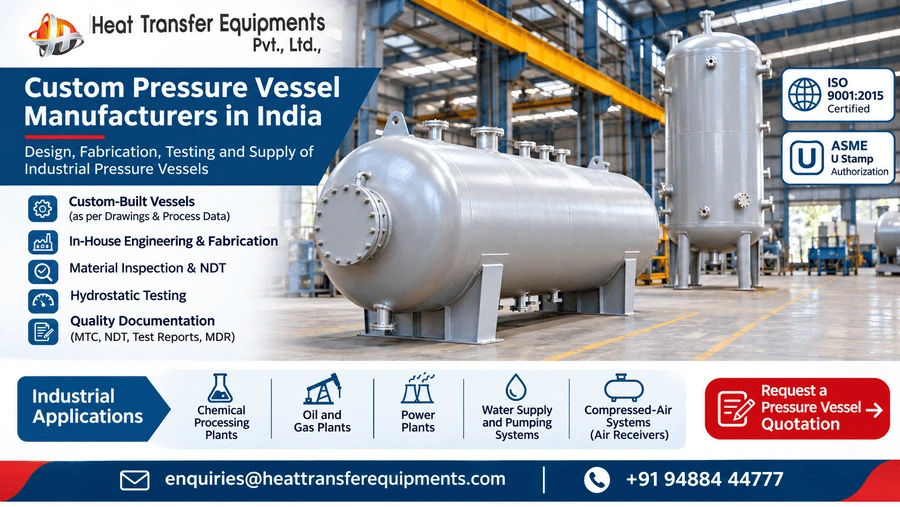
1. Pressure Vessel Manufacturers in India – HTEPL
Heat Transfer Equipments Pvt. Ltd. (HTEPL) is a pressure vessel manufacturer based in Coimbatore, Tamil Nadu, India. We take up custom pressure vessel requirements for industrial projects, with in-house engineering, fabrication and testing facilities.
If you have a vessel drawing or datasheet, send it to us along with the design pressure, temperature, material and service details. We use this information to review what needs to be manufactured, including the vessel dimensions, connections and inspection requirements.
For replacement vessels, the existing drawing is particularly useful. Two vessels may hold the same volume but have different nozzle locations or support arrangements. These differences can create installation problems when the new vessel reaches the plant.
Our company lists ISO 9001:2015 certification and ASME U Stamp authorization. If your project requires ASME-stamped construction, let us know so the applicable Code and inspection requirements can be reviewed.
Request a Pressure Vessel Quotation
2. List of Pressure Vessel Manufacturing Companies in India
India has many pressure vessel manufacturers serving chemical plants, refineries, power plants and other industries. Some build large vessels for high-pressure processes. Others focus on smaller vessels and custom equipment.
The table below lists 10 pressure vessel manufacturing companies in India, along with their locations and main products.
Top 10 Pressure Vessel Manufacturing Companies in India
The companies are listed for reference, not ranked by quality, size or sales.
| Company Name | Location | Manufacturing Specialization |
|---|---|---|
| Heat Transfer Equipments Pvt. Ltd. (HTEPL) | Coimbatore, Tamil Nadu | Custom pressure equipment and heat exchangers |
| Bharat Heavy Electricals Limited (BHEL) | Visakhapatnam, Andhra Pradesh | Heavy pressure vessels, columns and reactors |
| Fabri-Tek Engineers | Pune, Maharashtra | Custom pressure vessels, receivers and reactors |
| GMM Pfaudler Limited | Karamsad, Gujarat | Pressure vessels, process columns and reactors |
| Godrej Enterprises Group | Dahej, Gujarat | High-pressure vessels and heavy-wall reactors |
| Isgec Heavy Engineering Limited | Yamunanagar, Haryana; Dahej, Gujarat | Pressure vessels, columns and heat exchangers |
| KRR Engineering | Chennai, Tamil Nadu | Pressure vessels, separators and reactors |
| Larsen & Toubro – Heavy Engineering | Hazira, Gujarat | Large pressure vessels and refinery reactors |
| The Anup Engineering Limited | Ahmedabad, Gujarat | Process vessels for oil, gas and chemical plants |
| Umiya Steel Fabricators | Vadodara, Gujarat | Pressure vessels, reactors and heat exchangers |
How to Compare Pressure Vessel Manufacturers
Not every pressure vessel manufacturer can handle the same type of work. A company that builds large refinery reactors may not be the right choice for a small replacement vessel.
Before choosing a supplier, check whether it can manufacture your required vessel size, material and design pressure. Also ask about testing facilities, Code certification and inspection documents.
For example, a manufacturer may be able to fabricate a large vessel but lack the lifting equipment needed to handle it after assembly. Finding this out early can prevent delays.
The best choice is a manufacturer whose facilities and experience match your vessel requirements, not simply the biggest name on the list.
3. Types of Pressure Vessels Manufactured in India
Industrial pressure vessels are built for different purposes, including storing gases, holding process fluids and separating materials. The vessel may be horizontal or vertical, depending on the space available, its internal arrangement and how it will operate.
Horizontal and Vertical Pressure Vessels
Horizontal pressure vessels are supported by saddles and are commonly used for air storage, liquid storage and process duties. They need more floor space but can be useful where installation height is limited.
Vertical pressure vessels stand on legs, skirts or other suitable supports. They use less floor space and may suit processes where gas and liquid separate under gravity. However, enough height is needed for installation, piping and maintenance.
Orientation also affects the nozzle positions and internal arrangement. A vertical vessel cannot always replace a horizontal one simply because both have the same capacity.
Industrial Process Vessels and Custom-Built Pressure Vessels
Our pressure vessel range covers custom process vessels, storage vessels, separators and special-purpose equipment. We also manufacture air receiver tanks for compressed-air systems.
These vessels perform different jobs. An air receiver stores compressed air and helps handle changes in air demand. A separator removes gas or liquid from a process stream, while a process vessel may be used to hold materials under controlled pressure and temperature.
Surge vessels serve another purpose. They help control sudden pressure changes in pipelines when a pump stops or a valve closes quickly.
At HTEPL, we review the vessel type, intended service and installation requirements before confirming the suitable arrangement and manufacturing scope.
4. Custom Pressure Vessel Design and Engineering Capabilities
At HTEPL, we work with customer drawings and process data to review custom pressure vessel requirements. Before fabrication, we check the design conditions, vessel arrangement and connections to identify what the equipment needs.
Design Pressure, Temperature and Operating Requirements
The design pressure is not always the same as the normal operating pressure. A vessel must be designed for the pressure conditions specified for its service, including external pressure where applicable.
If the design pressure increases, the shell or head may need to be thicker. Temperature matters as well because a material's allowable strength can change at higher temperatures. The fluid also needs to be considered, particularly when corrosion is possible.
These conditions help determine the mechanical design and applicable construction requirements. They must be reviewed together rather than selected from vessel capacity alone.
Manufacturing Based on Client Drawings and Datasheets
Customers can send us a general arrangement drawing, vessel datasheet or fabrication drawing. We review the vessel dimensions, nozzle locations, supports and other details needed for manufacturing.
Changes after drawing approval need care. Moving a nozzle, for example, may require a new reinforcement check. If the design pressure increases, the existing shell thickness may no longer be suitable.
Such changes can affect the drawings, materials already ordered and fabrication work. A change that looks small on paper may require cutting or welding work to be repeated.
We therefore review drawing revisions against the agreed design requirements before proceeding with the affected fabrication work.
5. Pressure Vessel Materials, Specifications and Manufacturing Capacity
At HTEPL, we manufacture custom pressure vessels using materials selected for the fluid, pressure and temperature they must handle. The material also needs to suit the vessel's design life, corrosion conditions and applicable construction Code.
Carbon Steel, Stainless Steel and Other Materials
Carbon steel is suitable for many industrial pressure vessels, provided the fluid and operating conditions are compatible with it. Where corrosion is a concern, stainless steel or another suitable alloy may be required.
Temperature also affects material selection. Some carbon steel grades can become brittle at low temperatures, while high-temperature service may require steel with better strength at the design temperature.
| Material | Where It May Be Used |
|---|---|
| Carbon steel | General industrial vessels handling compatible fluids |
| Stainless steel | Vessels requiring greater corrosion resistance |
| Low-temperature carbon steel | Vessels exposed to low metal temperatures |
| Alloy steel | Applications requiring specific strength, temperature or corrosion properties |
The material grade must also be checked. For example, SS304 and SS316 have different corrosion resistance, so they cannot always be used interchangeably. We review the specified grade, fluid conditions and design requirements before confirming the material.
Vessel Dimensions, Capacity and Manufacturing Limits
We manufacture pressure vessels in custom sizes, subject to the design and our factory's fabrication capacity. Before accepting an order, we need to check whether the vessel can be formed, welded, lifted and tested using the available equipment.
Pressure and vessel diameter are closely linked. At the same design pressure and material, a larger shell diameter generally needs a thicker wall. This increases the vessel's weight and may affect plate rolling, welding and handling.
Length can create a different problem. A long vessel may be within the fabrication capacity of the workshop but difficult to move through the factory or transport to the site. These limits need to be checked before manufacturing begins.
For a new enquiry, send us the required vessel capacity, design pressure, temperature, material, diameter, length and estimated weight, where available. We can review these details against our fabrication and testing arrangements before confirming the manufacturing scope.
Discuss Your Pressure Vessel Requirements
6. Pressure Vessel Manufacturing and Fabrication Process
At HTEPL, pressure vessel fabrication starts with the approved drawings and material checks. The vessel then goes through cutting, forming, welding, inspection and pressure testing before dispatch. The exact work depends on the vessel design, material and construction standard.
- Drawing and material checks: We review the fabrication drawings before starting work. Steel plates, pipes and other pressure parts are checked against the required material specifications. Material identification and heat numbers help trace the parts back to their certificates, even after cutting.
- Cutting and forming: Plates are cut to size and rolled to form the vessel shell. The vessel heads are formed or procured according to the drawing. Shell sections and heads are then aligned and checked for fit before welding.
- Welding and assembly: The shell, heads, nozzles and supports are assembled using the required welding procedures and qualified welders. Nozzle positions need careful checking because even a small difference from the drawing can cause problems when connecting the vessel to existing piping.
- Inspection and heat treatment: Welds and dimensions are checked during fabrication. Required nondestructive tests are carried out according to the approved inspection plan. Some vessels also need post-weld heat treatment to reduce welding stresses. Whether this is required depends on the material, thickness, service conditions and design Code.
- Pressure testing: After the required fabrication checks and examinations, the vessel undergoes the specified pressure test. Hydrostatic testing uses water or another suitable liquid to check the pressure-containing parts for leakage and other unacceptable conditions.
- Finishing and dispatch: Once the required inspections and tests are accepted, the vessel is prepared for dispatch. This may include surface cleaning, painting, final marking and packing. The agreed inspection and manufacturing documents are completed before delivery.
The customer can request inspection at agreed stages of fabrication. For example, checking nozzle positions before final welding is easier than correcting them after the vessel has been completed.
7. ASME Pressure Vessel Standards and Manufacturing Certifications
Pressure vessels used in industrial plants may need to meet ASME Section VIII requirements. The required Code depends on the vessel design, operating conditions and project specifications. At HTEPL, we ask customers to confirm these requirements when sending their drawings or datasheets.
ASME Section VIII and U Stamp Requirements
ASME Section VIII, Division 1 covers the construction of many industrial pressure vessels. It sets rules for materials, design, welding, inspection and testing.
A vessel designed using ASME rules is not automatically U-stamped. For U-stamped construction, an authorized manufacturer must follow the required quality controls, involve an Authorized Inspector and complete the Code documentation before applying the ASME Certification Mark with the U designator.
This difference matters when placing an order. If U-stamped construction is required, it should be stated in the original enquiry. Adding the requirement after fabrication has started can create problems if the necessary inspections or records were not arranged from the beginning.
Quality Certifications and Code Compliance
HTEPL states that it holds ISO 9001:2015 certification and ASME U Stamp authorization for pressure equipment.
ISO 9001 covers the company's quality management system. It does not certify an individual pressure vessel as ASME-compliant. For a U-stamped vessel, the buyer should check the manufacturer's current ASME authorization and the completed vessel's certification records.
Before placing an order, customers can ask us to confirm the applicable Code, inspection requirements and documents to be supplied. For ASME-stamped equipment, these include the required Manufacturer's Data Report and vessel marking.
For more details, see our ASME U Stamp guide.
8. Pressure Vessel Inspection, Testing and Quality Documentation
Pressure vessel inspection checks the materials, welds and completed vessel before it leaves the factory. At HTEPL, we carry out material inspection and hydrostatic testing. Other examinations depend on the vessel design, construction Code and customer requirements.
NDT, Hydrostatic Testing and Inspection Requirements
Welds are checked for defects using suitable nondestructive testing (NDT) methods. Radiographic testing (RT) and ultrasonic testing (UT) can detect internal weld defects. Dye penetrant testing (PT) and magnetic particle testing (MT) are used to find surface defects where the material and method are suitable.
Not every vessel needs all these tests. The inspection method and extent depend on the material, weld type, design Code and approved inspection plan.
Hydrostatic testing is normally carried out after the required fabrication inspections. The vessel is filled with water or another suitable liquid and raised to the specified test pressure. This checks its pressure integrity and helps reveal leakage.
If the customer requires third-party inspection, the inspection stages should be agreed upon before fabrication begins. An inspector may need to witness material checks, welding stages or the pressure test. For ASME U-stamped construction, the required Authorized Inspector involvement must also be arranged.
Documents Buyers Should Receive Before Dispatch
Inspection reports help buyers check what was manufactured and tested against the approved specifications. The required documents should be agreed upon when placing the order.
| Document | What Buyers Can Verify |
|---|---|
| Material Test Certificates (MTC/MTR) | Material grade, test results and heat-number traceability |
| Approved and final drawings | Vessel dimensions, nozzle positions and design details |
| Welding records | Welding procedures and required welder qualifications |
| NDT reports | Examination methods, results and acceptance status |
| Hydrostatic test report | Test pressure, results and test acceptance |
| Inspection and dimensional reports | Required dimensions, visual checks and inspection status |
| Third-party inspection release | Acceptance of the agreed inspection stages, when required |
| ASME Manufacturer's Data Report | Code construction certification for applicable stamped vessels |
Additional records, such as post-weld heat treatment reports, may be needed depending on the vessel and project requirements.
Before dispatch, buyers should check that the material records match the vessel, the required tests are complete and any inspection issues have been closed. If a heat number cannot be traced to its material certificate, the buyer may have difficulty confirming which material was used.
We can review the required inspections and document list when you send us your vessel specifications or inspection and test plan (ITP).
9. Industrial Applications of Pressure Vessels
Pressure vessels are used in chemical plants, refineries, power stations, water treatment plants and other industrial systems. Their job may be to hold a fluid under pressure, separate gas from liquid, or control pressure changes. The vessel design depends on what happens inside it.
In chemical processing plants, pressure vessels hold liquids, gases or reacting materials. Some chemicals can attack carbon steel, so stainless steel or another suitable material may be needed. The choice depends on the chemical, its concentration and the operating temperature.
In oil and gas plants, separators are used to separate gas and liquid from a process stream. These vessels must handle the operating pressure and the properties of the fluids being separated. Internal parts, corrosion allowance and inspection access can also affect the design.
Power plants and factory utility systems use pressure vessels such as compressed-air receivers. An air receiver stores compressed air and helps meet changes in demand. Its working pressure, storage capacity and pressure cycling affect the design requirements.
In water supply and pumping systems, surge vessels help control sudden pressure changes when pumps stop or valves close quickly. The vessel size and gas volume must suit the pipeline conditions. A vessel that is too small may not provide enough protection against the expected pressure surge.
At HTEPL, we review the intended service along with the customer's operating details. Knowing whether the vessel will hold a corrosive chemical, compressed gas or water under changing pressure helps us assess the material, construction and inspection requirements for the enquiry.
10. How to Choose a Pressure Vessel Manufacturer in India
Choose a pressure vessel manufacturer that can meet your design requirements, manufacturing limits and inspection standards. Before selecting a supplier, check its experience with similar vessels and whether its facilities can handle the equipment you need.
Manufacturing Capability and Technical Selection Checklist
A manufacturer may be able to fabricate a small air receiver but not a large, heavy-wall process vessel. The difference comes down to the material, vessel dimensions, equipment available in the workshop and required testing.
Use this checklist when comparing pressure vessel manufacturers in India.
| What to Check | How to Verify |
|---|---|
| Manufacturing capacity | Ask for the maximum vessel diameter, length and handling weight. Check whether the complete vessel can be assembled and tested. |
| Materials | Confirm the required material grades and ask how material certificates and heat numbers are tracked. |
| Design and certification | Check experience with your design Code. For ASME-stamped vessels, verify the manufacturer's current authorization. |
| Welding and inspection | Ask about welding qualifications, NDT arrangements and pressure-testing facilities. |
| Quality documents | Confirm which drawings, material certificates and test reports will be supplied. |
| Delivery capability | Check the manufacturing schedule, finished vessel dimensions, transport arrangements and delivery terms. |
Questions to Ask Before Selecting a Manufacturer
Before placing an order, ask whether the manufacturer has built a vessel similar to yours. A photograph of completed equipment or a previous project reference can help you understand its experience.
Also check how the vessel will be tested. For example, a workshop may be able to roll and weld a large shell but lack the space or lifting equipment to test the completed vessel. The manufacturer should explain how it will handle this before accepting the order.
Find out who will review the drawings and whether third-party inspection can be arranged at the required stages. If your project needs ASME-stamped construction, confirm the authorization before fabrication starts.
The lowest quotation is not always the lowest final cost. A cheaper offer may exclude testing, inspection documents or transport. Compare the technical scope of each quotation before deciding.
At HTEPL, you can send us your vessel datasheet, drawings and inspection requirements for review before requesting a quotation.
11. Why Choose HTEPL for Pressure Vessel Manufacturing?
At Heat Transfer Equipments Pvt. Ltd. (HTEPL), we manufacture custom pressure vessels at our facility in Coimbatore, India. We have in-house engineering, fabrication, material inspection and hydrostatic testing facilities.
We work with customer drawings rather than limiting orders to standard vessel sizes. Our manufacturing work also includes custom air receiver tanks for compressed-air systems.
Before taking up a project, we review the vessel specifications against our fabrication and testing capabilities. For example, a large vessel may require special handling during assembly or pressure testing. We need to check these requirements before confirming the manufacturing scope.
Customers can also specify third-party inspection, testing and documentation requirements when sending an enquiry. We review these along with the drawings so the required work can be agreed upon before manufacturing begins.
HTEPL lists ISO 9001:2015 certification and ASME U Stamp authorization. The current certification scope should be confirmed for projects requiring ASME-stamped construction.
Discuss Your Pressure Vessel Requirement
12. Pressure Vessel Manufacturing and Supply Across India
We manufacture custom pressure vessels at our facility in Coimbatore, Tamil Nadu, and supply industrial equipment to customers across India. Our facility handles fabrication, inspection, testing and packing before dispatch.
Customers can arrange factory visits to check their equipment during manufacturing. If third-party inspection is required, let us know before placing the order so the inspection stages can be included in the production plan.
Transport needs attention when a vessel is large or heavy. The overall length, width, height and weight help determine the vehicle and lifting arrangements. A vessel may fit inside the factory but still need special transport because of road or height restrictions.
For large vessels, we review the shipping dimensions, lifting points and delivery location before finalizing the dispatch arrangements. This helps identify transport requirements before the equipment is ready to leave our factory.
13. How to Request a Custom Pressure Vessel Quotation
To get a custom pressure vessel quotation from HTEPL, send us your vessel drawing, technical datasheet or available operating details. We use this information to review the design requirements, material, manufacturing work and inspections needed for the project.
A complete datasheet helps us prepare a more accurate quotation. For example, two vessels with the same capacity may have different costs because one needs thicker steel, special materials or additional testing.
Technical Details Required for an Accurate Quotation
| Required Information | What to Provide |
|---|---|
| Vessel type and application | Air receiver, surge vessel, separator or other required vessel type |
| Capacity and dimensions | Required volume, diameter, length and horizontal or vertical arrangement |
| Pressure and temperature | Operating and design pressure, operating and design temperature |
| Fluid and material | Fluid handled, corrosive conditions and required material grade |
| Drawings and connections | General arrangement drawing, nozzle sizes, positions and support details |
| Design Code and inspection | Applicable ASME Code or other standard, NDT, pressure testing and documentation requirements |
| Project and delivery details | Quantity, delivery location and required delivery schedule |
If you do not have a complete drawing, send us the information available. For a replacement vessel, an existing drawing or nameplate details can help us understand the requirement. We can then identify what additional information is needed before the design and quotation are finalized.
You can submit your enquiry through our contact page or email your drawings and datasheet directly to enquiries@heattransferequipments.com.
Request a Custom Pressure Vessel Quotation
14. Frequently Asked Questions About Pressure Vessel Manufacturers in India
1. Which pressure vessel fabrication companies are located in India?
India has several pressure vessel manufacturers, including Heat Transfer Equipments Pvt. Ltd. (HTEPL) in Coimbatore, KRR Engineering in Chennai, L&T Heavy Engineering in Hazira and The Anup Engineering in Ahmedabad. These companies serve different industrial requirements. Buyers should check each manufacturer's vessel types, fabrication capacity and certifications before selecting a supplier.
2. What is an ASME-certified pressure vessel?
An ASME-certified pressure vessel is built and certified under the applicable ASME Boiler and Pressure Vessel Code. For Section VIII, Division 1 U-stamped vessels, the manufacturer must hold the required authorization and follow Code rules for construction, inspection and testing. A vessel designed using ASME rules is not automatically U-stamped. Buyers should check the vessel marking and Manufacturer's Data Report.
3. Can Indian manufacturers fabricate pressure vessels from client drawings?
Yes. Many Indian manufacturers accept customer drawings and technical datasheets for custom pressure vessel fabrication. The drawings should show the vessel dimensions, nozzle positions and supports. Design pressure, temperature, material and applicable standards are also needed. The manufacturer must check the design and resolve any missing details before fabrication begins.
4. What inspections and documents should a pressure vessel manufacturer provide?
A manufacturer should provide the inspection and manufacturing records required by the design Code and purchase order. These may include material test certificates, welding records, NDT reports, dimensional inspection reports and pressure-test results. ASME-stamped vessels also require the applicable Manufacturer's Data Report. Third-party inspection reports should be included when specified.
5. What information is required to get a custom pressure vessel quotation?
Send the vessel type, required capacity, design pressure, temperature, material and dimensions. Include drawings, nozzle details, design Code, inspection requirements and delivery location if available. At HTEPL, you can send your drawings or datasheet through our contact page. If some details are missing, mention them in your enquiry so we can review what is still needed.
15. Conclusion – Custom Pressure Vessel Manufacturer in India
Heat Transfer Equipments Pvt. Ltd. (HTEPL) manufactures custom industrial pressure equipment in Coimbatore, India. We have in-house engineering, fabrication and testing facilities to support customer requirements.
If you need a new or replacement pressure vessel, send us your drawings, datasheet or operating details. Our team can review the design pressure, temperature, material, vessel dimensions and applicable quality requirements before preparing a quotation.